DEF 14A: Definitive proxy statements
Published on April 9, 2026
UNITED STATES
SECURITIES AND EXCHANGE COMMISSION
Washington, D.C. 20549
Proxy Statement Pursuant to Section 14(a) of the Securities Exchange Act of 1934
(Amendment No. )
| Filed by the Registrant [X] | |
| Filed by a Party other than the Registrant [ ] | |
| Check the appropriate box: | |
| [ ] | Preliminary Proxy Statement |
| [ ] | Confidential, for Use of the Commission Only (as permitted by Rule 14a-6(e)(2)) |
| [X] | Definitive Proxy Statement |
| [ ] | Definitive Additional Materials |
| [ ] | Soliciting Material under §240.14a-12 |
| (Name of Registrant as Specified in Its Charter) |
| (Name of Person(s) Filing Proxy Statement, if other than the Registrant) |
| Payment of Filing Fee (Check the appropriate box): | ||
| [X] | No fee required. | |
| [ ] | Fee computed on table below per Exchange Act Rules 14a-6(i)(1) and 0-11. | |
| (1) | Title of each class of securities to which transaction applies: | |
| (2) | Aggregate number of securities to which transaction applies: | |
| (3) | Per unit price or other underlying value of transaction computed pursuant to Exchange Act Rule 0-11 (set forth the amount on which the filing fee is calculated and state how it was determined): | |
| (4) | Proposed maximum aggregate value of transaction: | |
| (5) | Total fee paid: | |
| [ ] | Fee paid previously with preliminary materials. | |
| [ ] | Check box if any part of the fee is offset as provided by Exchange Act Rule 0-11(a)(2) and identify the filing for which the offsetting fee was paid previously. Identify the previous filing by registration statement number, or the Form or Schedule and the date of its filing. | |
| (1) | Amount Previously Paid: | |
| (2) | Form, Schedule or Registration Statement No.: | |
| (3) | Filing Party: | |
| (4) | Date Filed: | |

KORU Medical Systems, Inc.
100 Corporate Drive
Mahwah, NJ 07430
800-624-9600
Notice of Annual Meeting of Shareholders
to be held on May 19, 2026
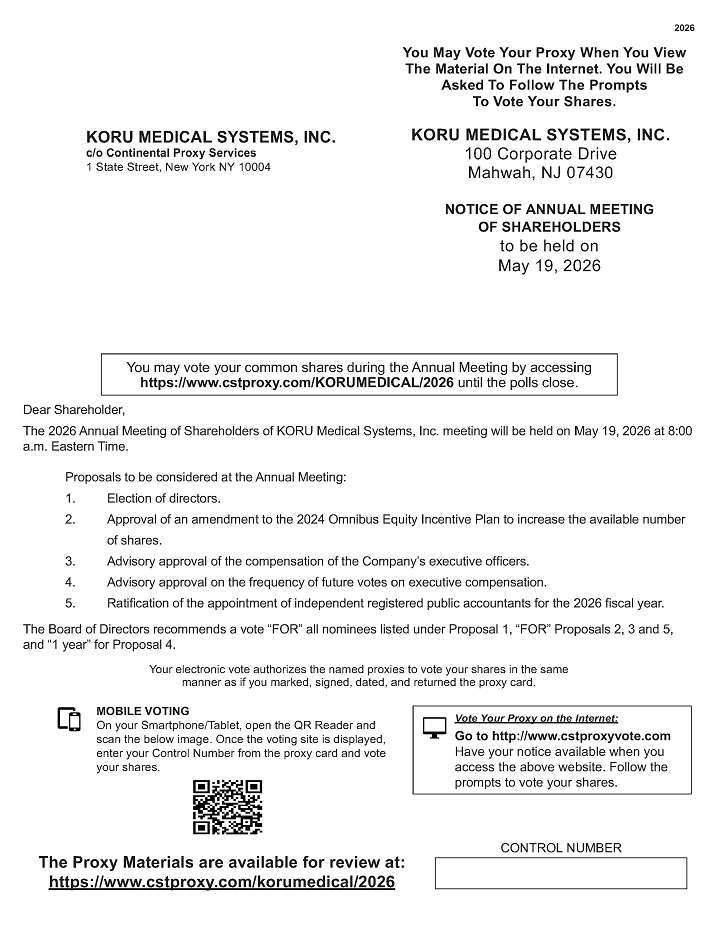
The 2026 Annual Meeting of Shareholders (the “Annual Meeting”) of KORU Medical Systems, Inc. (the “Company”) will be held on May 19, 2026 at 8:00 a.m. Eastern Time at the Company’s offices at 100 Corporate Drive, Mahwah, NJ 07430.
The Annual Meeting is to vote on the following matters:
| 1. | Election of directors | |
| 2. | Approval of an amendment to the 2024 Omnibus Equity Incentive Plan to increase the available number of shares | |
| 3. | Advisory approval of the compensation of the Company's executive officers | |
| 4. | Advisory approval on the frequency of future votes on executive compensation | |
| 5. | Ratification of the appointment of independent registered public accountants | |
| 6. | Transaction of any other business that may properly come before the meeting |
The Company will also transact any other business that may properly come before the meeting.
All shareholders are invited to attend the Annual Meeting. Only those shareholders of record at the close of business on March 16, 2026 are entitled to notice of and to vote at the Annual Meeting and any postponements or adjournments thereof. A complete list of shareholders entitled to vote at the Annual Meeting will be available for inspection by any shareholder at the Annual Meeting and during normal business hours at the Company’s corporate headquarters during the 10-day period immediately prior to the date of the Annual Meeting. Officers of the Company will be present at the Annual Meeting and available to respond to questions from shareholders.
YOUR VOTE IS IMPORTANT. Whether or not you plan to attend the Annual Meeting, we urge you to vote and submit your proxy in advance of the meeting by one of the methods described in the proxy materials for the Annual Meeting. Shareholders who attend the Annual Meeting may revoke any previously submitted proxies and vote in person, by internet or by mobile device up until the polls close during the Annual Meeting.
How to Vote:
|
|
Internet |
Mobile Device |
| Sign, complete and return the proxy card in the postage paid envelope provided | www.cstproxy.com/korumedical/2026 - have your proxy card available when logging in |
Scan this QR code:
|

Important Notice Regarding the Availability of Proxy Materials for the Meeting to be Held on May 19, 2026: This Proxy Statement, along with our Annual Report on Form 10-K for the fiscal year ended December 31, 2025 is available at https://www.cstproxy.com/korumedical/2026.
By order of the Board of Directors,
Thomas Adams
Chief Financial Officer, Treasurer and Corporate Secretary
KORU Medical Systems, Inc.
100 Corporate Drive
Mahwah, NJ 07430
800-624-9600
Proxy Statement
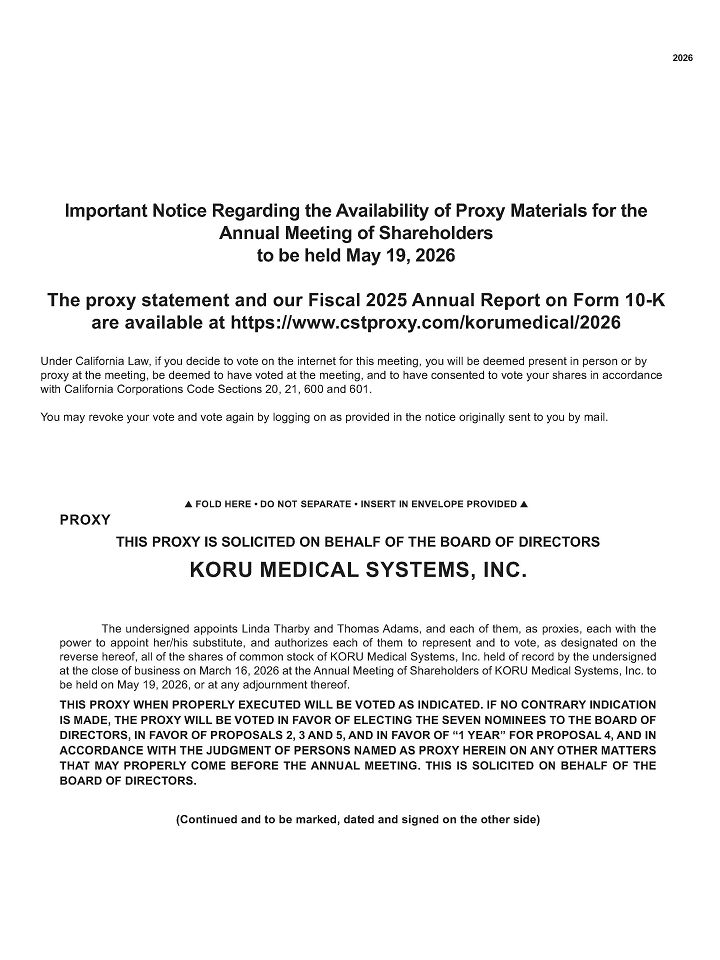
This Proxy Statement is furnished in connection with the solicitation of proxies by the Board of Directors of KORU Medical Systems, Inc. (the “Company” or “KORU Medical” and, as the context requires, “we”, “us” or “our”) to be used at the Company’s 2026 Annual Meeting of Shareholders to be held on May 19, 2026 at the time and place and for the purposes set forth in the accompanying Notice of Annual Meeting of Shareholders, and at any postponements or adjournments thereof. All proxies will be voted in accordance with the shareholders’ instructions, and if no choice is specified, the proxies will be voted in favor of the matters specified in the accompanying Notice of Annual Meeting of Shareholders and each of the director nominees specified herein. Any proxy may be revoked by a shareholder before its exercise by delivery of written revocation or a subsequently dated proxy to our Corporate Secretary by the close of business on May 18, 2026 or by voting again by internet or mobile device prior to or at the Annual Meeting before the polls close.
Notice of Electronic Availability of Proxy Materials
On or about April 9, 2026, we mailed to our shareholders of record and beneficial owners a Notice of Internet Availability of Proxy Statement (“Notice”) containing instructions on how to access this proxy statement and our 2025 Annual Report on Form 10-K via the Internet and how to vote online or by mobile device. This Proxy Statement, along with our Annual Report on Form 10-K for the fiscal year ended December 31, 2025 is available at http://www.cstproxy.com/korumedical/2026. As a result, you will not receive a paper copy of the proxy materials unless you request one. All shareholders are able to access the proxy materials on the website referred to in the Notice and in this proxy statement and to request to receive a set of the proxy materials by mail or electronically, in either case, free of charge. If you would like to receive a paper or electronic copy of our proxy materials, you should follow the instructions for requesting such materials in this proxy statement.
Questions and Answers about the Annual Meeting
What is the record date?
The record date for the determination of shareholders entitled to notice of and to vote at the Annual Meeting is the close of business on March 16, 2026. The record date is established by the Board of Directors as required by Delaware law. On the record date, 47,490,432 shares of the Company’s common stock, par value $0.01 per share (“shares” or “common stock”), including 880,000 shares of unvested restricted common stock entitled to vote, were issued and outstanding.
Who is entitled to vote?
All record holders of shares as of the close of business on the record date are entitled to vote.
What are the voting rights of shareholders?
Each holder of shares is entitled to one vote per common share on all matters to be acted upon at the Annual Meeting. Neither the Company’s Certificate of Incorporation, nor Bylaws allow for cumulative voting rights.
- 1 -
What constitutes a quorum for the Annual Meeting?
A majority of the outstanding shares of common stock entitled to vote, represented at the meeting in person or by proxy, constitutes a quorum. Broker non-votes and abstentions will be counted for purposes of determining whether a quorum is present.
How do I vote my shares?
KORU Medical offers registered shareholders these ways to vote:
| ● | By mail (if you received your proxy materials by mail), using the enclosed proxy card and return envelope; | |
| ● | By Internet or mobile device, following the instructions on the Notice or the proxy card, prior to or at the Annual Meeting; or | |
| ● | By submitting a ballot in person at the Annual Meeting. |
How do I attend the Annual Meeting? What do I need to bring?
In order to be admitted to the Annual Meeting, you must bring documentation showing that you owned shares as of March 16, 2026, the record date. Acceptable documentation includes (i) your Notice of Internet Availability of Proxy Materials, (ii) the admission ticket attached to your proxy card (if you received your proxy materials by mail), or any other proof of ownership (such as a brokerage or bank statement) reflecting your KORU Medical holdings as of March 16, 2026. All attendees must also bring valid photo identification. Shareholders who do not bring this documentation will not be admitted to the Annual Meeting.
Can I vote my shares during the Annual Meeting?
Yes. If you are a shareholder of record, you may vote your shares during the Annual Meeting by accessing https://www.cstproxy.com/korumedical/2026 until the polls close or by completing a ballot at the meeting. However, if your shares are held in “street name,” you may vote your shares in person only if you obtain a nominee-issued proxy from your broker or nominee giving you the right to vote the shares. Even if you currently plan to attend the Annual Meeting, we recommend that you also submit your proxy as described above so that your vote will be counted if you later decide not to attend the meeting.
What is the difference between a shareholder of record and a “street name” holder?
If your shares are registered directly in your name with Continental Stock Transfer & Trust Company, the Company’s transfer agent, you are considered the shareholder of record with respect to those shares. The Notice and proxy card have been sent directly to you by the Company.
If your shares are held in a stock brokerage account or by a bank or other nominee, you are considered the beneficial owner of these shares, and your shares are held in “street name.” The Notice and proxy card have been forwarded to you by your broker, bank or nominee who is considered, with respect to those shares, the shareholder of record.
How do I vote shares that are held by my broker?
If you have shares held by a broker or other nominee, you may instruct your broker or other nominee to vote your shares by following instructions that your broker or nominee provides to you. Most brokers offer voting by mail and the Internet.
- 2 -
What if I do not specify how I want my shares voted?
If you return a signed proxy card and do not specify on your proxy card (or when giving your proxy over the Internet or mobile device) how you want to vote your shares, your shares will be voted FOR each of the directors nominated in Proposal 1, and FOR each of the proposals set forth in Proposals 2, 3 and 5 and FOR ONE YEAR for Proposal 4.
Broker non-votes occur when nominees, such as banks and brokers holding shares on behalf of beneficial owners, do not receive voting instructions from the beneficial holders. If that happens, the banks and brokers who are registered with the New York Stock Exchange (NYSE) may vote those shares only on matters deemed “routine” by the NYSE, such as the ratification of the appointment of the Company’s independent registered public accounting firm. On “non-routine” matters nominees cannot vote unless they receive voting instructions from beneficial owners, resulting in so called “broker non-votes.” The items being considered at the Annual Meeting, except for the ratification of the appointment of the Company’s independent registered public accounting, are considered “non-routine” matters. Therefore, it is important that you provide voting instructions to your broker as to how you want your shares voted on the proposals being submitted at the Annual Meeting.
How do I find out the voting results?
Preliminary results are typically announced at the Annual Meeting. Final voting results will be reported on a Form 8-K filed with the Securities and Exchange Commission following the Annual Meeting.
What are my choices when voting?
Shareholders may vote “for,” “against” or abstain from voting with respect to each of Proposals 2, 3 and 5 described in the Notice and this Proxy Statement. Shareholders may vote “for” or “against” all or some of the nominees, or abstain from voting with respect to one or more of the nominees with respect to Proposal 1 (Election of Directors). Shareholders may vote for “ONE YEAR”, “TWO YEARS”, “THREE YEARS” or abstain from voting with respect to Proposal 4.
What are the recommendations of the Board of Directors on how I should vote my shares?
The Board of Directors recommends that you vote your shares FOR each of the director nominees in Proposal 1 and FOR each of Proposals 2, 3 and 5 and FOR ONE YEAR for Proposal 4 as set forth in the Notice and this Proxy Statement.
Can I change my vote?
Yes. You may revoke your proxy at any time by any of the following means:
| ● | Attending the Annual Meeting and voting by one of the methods described in the proxy materials for the Annual Meeting. Your attendance at the Annual Meeting will not by itself revoke a proxy. You must vote your shares at the meeting to revoke your proxy. If your shares are held in “street name,” you will need a nominee-issued proxy from your broker to vote your shares at the meeting. | |
| ● | Completing and submitting a new valid proxy bearing a later date by Internet, mobile device or mail before 11:59 pm on May 18, 2026. | |
| ● | Giving written notice of revocation to the Company addressed to Corporate Secretary, at the Company’s address above, which notice must be received before the close of business on May 18, 2026. |
- 3 -
What percentage of the vote is required to elect the nominees to the Board of Directors?
To be elected as a director (Proposal 1), each director nominee must receive a majority of the votes cast at the Annual Meeting by the shareholders entitled to vote in the election of directors. A majority of the votes cast means that the number of shares voted “for” a nominee must exceed the votes cast “against” such nominee’s election. Should any
director nominee become unable or unwilling to accept nomination or election, the proxy holders may vote the proxies for the election, in his or her stead, of any other person the Board of Directors may nominate or designate. Each director nominee has expressed his intention to serve the entire term for which election is sought. Broker non-votes and abstentions will have no effect on the outcome of Proposal 1.
What percentage of the vote is required to approve the Plan Amendment to the 2024 Omnibus Equity Incentive Plan?
Approval of the Plan Amendment to the 2024 Omnibus Equity Incentive Plan (Proposal 2) requires the affirmative vote of a majority of the shares present at the Annual Meeting or represented by proxy at the Annual Meeting and entitled to vote. Broker non-votes and abstentions will have no effect on the outcome of Proposal 2.
What percentage of the vote is required to approve the advisory vote regarding executive compensation?
The affirmative vote of a majority of the votes cast for or against at the Annual Meeting by the shareholders entitled to vote thereon is required to approve, by advisory vote, the Company’s executive compensation described in this proxy statement (Proposal 3). This is a non-binding advisory vote. Broker non-votes and abstentions will have no effect on the outcome of Proposal 3.
What percentage of the vote is required to approve the advisory vote on frequency of future advisory votes on executive compensation?
There is no threshold vote that must be obtained for the advisory vote on frequency of future advisory votes on executive compensation (Proposal 4). The Company will consider the frequency that receives the highest number of votes by shareholders to be the frequency that is preferred by shareholders. Unless instructions to the contrary are specified, the proxy holders will vote the proxies received by them for ONE YEAR with respect to Proposal 4. This is a non-binding advisory vote. Broker non-votes and abstentions will have no impact on the outcome of Proposal 4.
What percentage of the vote is required to ratify the appointment of independent registered accountants?
The affirmative vote of a majority of the votes cast in favor of or against such action at the Annual Meeting by the shareholders entitled to vote thereon is required to ratify the appointment of the independent registered accountants (Proposal 5). This is a non-binding advisory vote. Broker non-votes and abstentions will have no effect on the outcome of Proposal 5.
How are votes counted?
Votes will be counted by the inspector of election appointed for the Annual Meeting, who will separately count “FOR” and “AGAINST” votes, abstentions and broker non-votes with respect to Proposal 1, Proposal 2, Proposal 3 and Proposal 5, and “ONE YEAR”, “TWO YEARS”, and “THREE YEARS” votes, abstentions and broker non-votes with respect to Proposal 4. A broker non-vote occurs when a nominee, such as a broker or bank, holding shares for a beneficial owner does not vote on a particular proposal because the nominee does not have discretionary authority to vote with respect to that proposal and has not received instructions with respect to that proposal from the beneficial owner. In the event that a broker, bank, custodian, nominee or other record holder of our common stock indicates on a proxy that it does not have discretionary authority to vote certain shares on a particular proposal, then those shares will be treated as broker non-votes with respect to that proposal. Accordingly, if you own shares through a nominee, such as a broker or bank, please be sure to instruct your nominee how to vote to ensure that your vote is counted on each of the proposals.
- 4 -
Abstentions and broker non-votes will be treated as shares present for the purpose of determining the presence of a quorum for the transaction of business at the Annual Meeting, but broker non-votes and abstentions will not be counted for purposes of determining the number of shares present at the Annual Meeting or represented by proxy and entitled to vote with respect to a particular proposal. Therefore, a broker non-vote and abstention will not affect the outcome of the vote on any of the proposals.
Is this proxy statement the only way that proxies are being solicited?
No. In addition to the solicitation of proxies by use of the mail, officers and employees of the Company may solicit the return of proxies by mail, telephone, facsimile or e-mail or through personal contact. These officers and employees will not receive additional compensation but will be reimbursed for out-of-pocket expenses. Brokerage houses and other custodians, nominees and fiduciaries, in connection with shares registered in their names, will be requested to forward solicitation materials to the beneficial owners of shares.
Are there any other matters to be acted upon at the Annual Meeting?
Management does not intend to present any business for a vote at the Annual Meeting other than the matters set forth in the Notice and has no information that others will do so. If other matters requiring a vote of the shareholders properly come before the Annual Meeting, it is the intention of the persons named in the accompanying form of proxy to vote the shares represented by the proxies held by them in accordance with applicable law and their discretion on such matters.
What does it mean to vote by proxy?
It means that you give someone else the right to vote your shares in accordance with your instructions. In this way, you ensure that your vote will be counted even if you are unable to attend the Annual Meeting. If you give your proxy but do not include specific instructions on how to vote, the individuals named as proxies will vote your shares “FOR” each of the director nominees and FOR Proposals 2, 3 and 5, and FOR ONE YEAR on Proposal 4.
Who is paying the costs of soliciting proxies?
We will pay all costs associated with soliciting proxies related to this Proxy Statement.
What is “householding” and how does it affect me?
KORU Medical has adopted “householding,” a procedure under which shareholders of record who have the same address and last name will receive a single Notice of Internet Availability of Proxy Materials or set of proxy materials, unless one or more of these shareholders notifies the Company that they wish to continue receiving individual copies. Shareholders who participate in householding will continue to receive separate proxy cards. This procedure can result in significant savings to the Company by reducing printing and postage costs.
If you participate in householding and wish to receive a separate Notice of Internet Availability of Proxy Materials or set of proxy materials, or if you wish to receive separate copies of future notices, special reports and proxy materials, please contact Continental Transfer & Trust Company at 1 State Street 30th floor, New York, NY 10004, phone (212) 509-4000. The transfer agent will deliver the requested documents to you promptly upon your request.
Any shareholders of record who share the same address and currently receive multiple copies of proxy materials who wish to receive only one copy of these materials per household in the future may contact Continental Transfer & Trust Company at the address or telephone number listed above. If you hold your shares through a broker, bank or other nominee, however, please contact your broker, bank, or other nominee to request information about householding.
Are there rights of dissent or appraisal for the proposals submitted at the Annual Meeting?
None of the matters to be acted on at the Annual Meeting give rise to any statutory right of a shareholder to dissent and obtain the appraisal of or payment for such shareholder’s shares.
- 5 -
Proposal 1: Election of Directors
✔ The Board recommends a vote “FOR” each of the nominees for director.
The Company’s Board of Directors (the “Board”) currently has 7 members, and all of our current directors are standing for election at the 2026 Annual Meeting.
Members of the Board are elected to serve a term of one year and until their successors have been elected and qualified. All of the nominees for director have consented to being named in this proxy statement and to serve if elected. Shareholders will be unable to vote their proxies for more than 7 persons.
The Company does not know of any reason why any nominee would be unable to serve as director. If any nominee is unable to serve, the shares represented by valid proxies will be voted for the election of such other person as the Board may nominate, or the size of the Board may be reduced.
None of our current directors or executive officers have been, during the past 10 years, involved in any legal proceedings required to be disclosed pursuant to Item 401(f) of Regulation S-K. There are no family relationships between or among any of our directors and executive officers.
The Company’s directors have a variety of backgrounds, which reflects the Board’s continuing efforts to achieve a diversity of viewpoints, insights and perspectives on the Board. As more fully discussed below, director nominees are considered on the basis of a range of criteria, including their business knowledge and background, prominence and reputation in their fields and commitment to strong corporate governance and citizenship. They must also have experience and ability that is relevant to the Board’s oversight of the Company’s business and affairs. Each nominee’s biography starting on page 7 includes the particular experience and qualifications that led the Board to conclude that the nominee should serve on the Board.
| Committee Membership* | |||||
| Nominee | Age | Director Since | AC | CC | NGC |
| R. John Fletcher Chairman of the Board Managing Partner Emeritus, Fletcher Spaght Inc. |
80 | 2019 | M | M | C |
| Robert A. Cascella Former CEO of Precision Diagnostics, Royal Phillips |
71 | 2022 | C | ||
| Donna French, PhD VP Dosage Form Design and Development, AstraZeneca |
61 | 2021 | M | ||
| Joseph M. Manko, Jr. Senior Principal, Horton Capital Management LLC |
60 | 2016 | M | M | M |
| Shahriar (Shar) Matin CEO, Cirtec Medical |
51 | 2021 | C | M | |
| Edward Wholihan Former CFO Medical Specialties Distributors |
66 | 2023 | |||
| Linda Tharby CEO and former President, KORU Medical |
57 | 2022 | |||
* As of April 2, 2026
| AC - Audit Committee | C – Chair |
| CC – Compensation Committee | M – Member |
| NGC –Nominating & Corporate Governance Committee |
- 6 -
Skills & Experience
The table below summarizes the key qualifications, skills and attributes of the nominees for director that served as the basis for the Board’s decision to nominate these individuals for election.
| Skills & Experience & Attributes | Fletcher | Cascella | French | Manko | Matin | Tharby | Wholihan |
| Market Knowledge - Distribution | ✔ | ✔ | ✔ | ✔ | ✔ | ||
| Market Knowledge - Specialty Pharma | ✔ | ✔ | ✔ | ✔ | |||
| Market Knowledge - Biopharma | ✔ | ✔ | ✔ | ✔ | ✔ | ✔ | |
| Medtech Industry Experience | ✔ | ✔ | ✔ | ✔ | ✔ | ✔ | ✔ |
| Medtech Operational Experience | ✔ | ✔ | ✔ | ✔ | ✔ | ||
| Healthcare Growth Experience | ✔ | ✔ | ✔ | ✔ | ✔ | ✔ | ✔ |
| International Healthcare Experience | ✔ | ✔ | ✔ | ✔ | ✔ | ✔ | |
| Product Development | ✔ | ✔ | ✔ | ✔ | ✔ | ✔ | |
| Capital Markets Experience | ✔ | ✔ | ✔ | ✔ | ✔ | ||
| Financial Expertise/Audit Committee Experience | ✔ | ✔ | ✔ | ✔ | ✔ | ||
| C-level Expertise | ✔ | ✔ | ✔ | ✔ | ✔ | ✔ | ✔ |
| Other Public Company Director Experience | ✔ | ✔ | ✔ | ||||
| Independent | ✔ | ✔ | ✔ | ✔ | ✔ |
- 7 -
Nominees for Director
R. John Fletcher
Mr. Fletcher brings more than 40 years of healthcare and medical device experience to KORU. He currently serves as Managing Partner Emeritus of Fletcher Spaght Inc., a healthcare-focused strategy consulting firm which he founded in 1983, and Managing Partner of Fletcher Spaght Ventures, a venture capital firm which he founded in 2001. Mr. Fletcher joined the Board of Directors of publicly-traded medical device company Spectranetics Corporation in 2002 and served as Chairman of the Board from 2010-2017. Mr. Fletcher was named 2018 Director of the Year by The National Association of Corporate Directors (NACD) for his work at Spectranetics and Axcelis. Mr. Fletcher currently serves as Chairman of ClearPoint Neuro (formerly MRI Interventions) and is Chairman of Metabolon, Inc., as well as, Chairman of the Board of Optinose, Inc. He is Chairman Emeritus of the Corporate Collaboration Council at the Thayer School of Engineering/Tuck School of Business at Dartmouth College and serves on the Board of Advisors of Beth Israel Deaconess Medical Center and the Whitehead Institute at MIT. Mr. Fletcher received his MBA from Southern Illinois University, a BBA in Marketing from George Washington University and an MS in international finance from Central Michigan University. Mr. Fletcher was also an instructor and PhD candidate at the Wharton School, University of Pennsylvania.
Robert A. Cascella
Over more than 30 years, Mr. Cascella has supported value creation in the healthcare industry, with a strong focus on innovation and integrated solutions. Mr. Cascella retired from Philips on December 31, 2021, after working for the company since 2015. The last position he held before retiring was Executive Vice President and Strategic Business Development Leader and was also a member of the company’s Executive Committee. Prior to that role, Mr. Cascella was the CEO for the Precision Diagnosis Segment, responsible for the integration of smart systems, software, informatics and services dedicated to delivering on the promise of precision medicine. Prior to that role, Mr. Cascella was the CEO of the Diagnosis and Treatment Segment, where he was responsible for the development and growth of modality-based diagnostics and interventional treatment and therapy. Before joining Philips, Mr. Cascella spent 11 years at Hologic, a global leader in Women’s Health, as its president, and later, its CEO. Under his leadership, Hologic broadly diversified its product portfolio and substantially grew revenues through a combination of innovative product development and acquisition, as well as the building of strong customer relationships. Mr. Cascella serves as a board director for Celestica (NYSE: CLS), Mirion Technologies (NYSE: MIR) and Neuronetics (Nasdaq: STIM). He is also a NACD certified director. Mr. Cascella holds a Bachelor of Arts in accounting from Fairfield University.
Donna French
Dr. French, Ph.D., is a pharmaceutical industry veteran with over 30 years of experience in pharmaceutical sciences and drug-device combination products. Dr. French, has been Vice President of Dosage Form Design and Development at AstraZeneca since June 2017. Prior to joining AstraZeneca, Dr. French was Senior Director of Device Development at Genentech from January 2009 to May 2017. She was Executive Director of Drug Delivery Engineering at Amgen, Inc. before joining Genentech. For her entire career, Dr. French has been developing and commercializing drug products, drug delivery systems and devices. She has led the development and commercialization of numerous products with delivery devices worldwide, including auto-injectors, pen injectors, needle stick prevention devices, prefilled syringes, needle-free injectors, subcutaneous infusion devices, intraocular delivery devices, inhalation drug delivery systems, and patient aids and tools for drug preparation and administration. Dr. French earned her B.S. in Pharmacy from Albany College of Pharmacy, and her Ph.D. in Pharmaceutical Sciences from the University of Nebraska.
Joseph M. Manko, Jr.
Mr. Manko has been the Senior Principal in Horton Capital Management LLC, the investment manager for the Horton Capital Partners Fund, LP (“Horton Fund”) since 2013. The Horton Fund is a significant shareholder in the Company. Mr. Manko has over 20 years of investment experience in the asset management, investment banking, private equity and corporate securities markets. From 2005 to 2010, Mr. Manko was a Partner and Chief Executive Officer of Switzerland-based BZ Fund Management Limited, where he was responsible for corporate finance, private equity investments, three public equity funds and the firm’s Special Situations and Event-Driven strategies. Prior to that Mr. Manko was a Managing Director with Deutsche Bank in London. He began his investment banking career at Merrill Lynch as a Vice President in Hong Kong and prior to that, Mr. Manko was a corporate finance attorney at Skadden, Arps, Slate, Meagher & Flom LLP. Mr. Manko has served on the board of several companies in the bio-pharmaceutical industry and has advised numerous companies in the pharmaceutical, biotech and medtech industries and currently serves as a director and Chairman of Safeguard Scientifics, Inc., and previously served as a director of Wireless Telecom Group, Inc., One Stop Systems, Inc., and Creative Realities, Inc. Mr. Manko earned both his B.A. and Juris Doctor from the University of Pennsylvania.
- 8 -
Shahriar (Shar) Matin
Mr. Matin has over 25 years of medical technology experience and has served since 2025 as Chief Executive Officer of Cirtec Medical, a leading medical device design and manufacturer. Prior to that, he was Chief Executive Officer of Cordis Corporation, a leading cardiovascular medical device company, from 2021 to 2023. Previously, he was the Chief Operating Officer at ViewRay Technologies Inc., an early-stage radiation oncology medical technology firm, from July 2018 to March 2021. Prior to that, he served as Chief Operating Officer of Spectranetics from January 2014 until its sale to Royal Philips in November 2017. From 2007 – 2014, Mr. Matin held commercial and operation leadership roles of increasing responsibilities at Spectranetics. Mr. Matin started his career in several commercial and engineering leadership roles at Boston Scientific and Guidant Corporation. He earned a BS in Mechanical Engineering from the University of California, Berkeley, with honors, and an MBA from Harvard Business School.
Edward Wholihan
Mr. Wholihan has over 25 years of experience as a chief financial officer driving growth and shareholder value for public, private equity-sponsored, and venture capital-funded life sciences and healthcare businesses. Most recently he has leveraged his strategic management, financial, and operational expertise consulting for various companies. Prior, he served as the Chief Financial Officer for Rarebreed Veterinary Partners, Inc, a community of veterinary hospitals; CFO of Allena Pharmaceuticals, Inc., a development stage biopharmaceutical company; and CFO of Medical Specialties Distributors, a leading solution provider to the specialty pharmacy, home infusion, and oncology practice markets that was acquired by McKesson Corp (NYSE: MCK) in 2018. Mr. Wholihan also held two other CFO roles within the life science sector earlier in his career and, prior to that, spent seven years as a management strategy consultant for McKinsey & Company. He earned his MBA from Stanford University's Graduate School of Business and a BA in economics from Yale University.
Linda Tharby
Ms. Tharby was appointed as President and CEO in April 2021, and resigned as President on March 15, 2026. Ms. Tharby has over 25 years of executive leadership experience building and leading strong performing global organizations that develop and commercialize products and service innovations, while delivering solutions to patients in the home setting. Prior to joining KORU, Ms. Tharby spent the last 24 years working in various roles of increased responsibility at Becton Dickinson (“BD”). Ms. Tharby was a member of the Executive Leadership team of BD. From 1998 to 2016, she held numerous senior global business leadership roles at BD, including Executive Vice President and President of Life Sciences, Group President of Pre-Analytical Systems and Biosciences, Worldwide President of Diabetes Care, and Vice President/General Manager of Pharmaceutical Systems. Ms. Tharby’s last role was as Chief Customer Experience Officer from July 2018 through December 2020. Prior to that she served as BD’s Chief Human Resources Officer, from October 2016 through July 2018. Ms. Tharby has an Honors Bachelor of Business Administration from Wilfrid Laurier University in Waterloo, Ontario Canada.
In connection with her retirement from KORU Medical, Ms. Tharby has entered into an agreement with the Company whereby she will resign as the Company’s Chief Executive Officer as of June 30, 2026 and from the Board effective December 31, 2026.
Board Assessment, Nomination & Diversity
Our Board members have extensive experience in business, finance, healthcare and enterprise growth, as well as developing successful Company strategies. The Board strives to obtain and retain the right mix of skills and experiences on the Board to drive the Company’s success. To that end, the Board performs annual self-assessments and engages in a thorough director nomination process.
Board Self-Evaluation Process
The Board and its committees conduct an annual self-evaluation of their respective performances that allows directors to provide individual and confidential feedback on the Board’s composition, structure, committee structure, effectiveness, relationship with management, meetings, and other Board-related topics. The results of the self-evaluation are presented by the chair of the Nominating and Corporate Governance Committee (the “Nominating and Governance Committee”) to the full Board. The Board then assesses progress made in areas targeted for improvement from the prior year’s self-evaluation and develops an action plan in response to the current year’s self-evaluation.
- 9 -
Director Nomination Process
The Nominating and Governance Committee makes its recommendations of director candidates to the full Board, after considering candidates’ depth of experience, availability and potential contributions to the Board, as well as their qualification as “independent” under the standards applicable to the Board and its committees. With respect to incumbent members of the Board, the committee will also consider the prior performance of each incumbent director.
In selecting qualified candidates to serve as directors of the Company, a wide range of diversity criteria are considered, including without limitation, gender, race, ethnicity, religion, sexual orientation, physical ability and age, with the objective that the Board, as a whole, reflects a range of viewpoints, backgrounds, skills and experience. In the process of searching for qualified persons to serve on the Board, the Nominating and Governance Committee strives for the inclusion of diverse groups, knowledge, and viewpoints. To accomplish this, the Committee may retain an executive search firm to help meet the Board’s diversity objectives.
Candidates may come to the attention of the Nominating and Governance Committee from current or former directors, shareholders, officers or other sources, and the committee reviews all candidates in the same manner regardless of the source of the recommendation. In addition to those candidates identified through its own internal processes, the Nominating and Governance Committee will consider nominees recommended by shareholders who submit their recommendations in accordance with the notice, information and consent requirements set forth in our Bylaws.
Our Bylaws provide that a shareholder who wishes to nominate a person for election as a director provide timely notice to the Chairman of the Board. The timeline requirements set out in our Bylaws can be found in this Proxy Statement under the section titled “2027 Annual Meeting of Shareholders” located on page 28. The shareholder’s notice must include: (i) the name and business address of the shareholder (ii) the name and address of the shareholder as they appear on the Company’s books (if they so appear); (iii) the class and number of shares of the Company beneficially owned by the shareholder; (iv) any agreements or arrangements between the shareholder, the nominee or any other person; (v) whether the shareholder intends or is part of a group that intends to deliver a proxy statement and form of proxy to holders of at least the percentage of the shares of the Company entitled to vote on director nominees; (vi) solicit proxies in support of the proposed nominee; (vii) whether the shareholder intends to appear at the annual meeting to make such nomination; and (viii) a certification that the shareholder has complied with all federal, state and other legal requirements in connection with the shareholder’s acquisition of shares of the Company and/or the shareholder’s acts or omissions as the shareholder of the Company. The notice must also contain information about the nominee, including (i) all information relating to the nominee that is required to be disclosed in a proxy statement or other filings under Section 14 of the Exchange Act; (ii) a description of all direct and indirect compensation or other monetary agreements or arrangements during the past three years between the shareholder and nominee; and (iii) a completed and signed questionnaire, representation and agreement by the nominee regarding voting agreements, compensation, reimbursement and indemnification arrangements, compliance with corporate governance policies, and agrees to serve if elected as a director.
The foregoing summary does not include all requirements a shareholder must satisfy in order to nominate a candidate to our Board. Shareholders who wish to recommend a nominee to our Board should carefully read our Bylaws, which are available on the “Investors” page of our website under the Governance tab at www.korumedical.com. The inclusion of our website address in this Proxy Statement does not include or incorporate by reference the information on our website into this Proxy Statement.
Director Diversity
The Board believes having Board members with a diverse mix of viewpoints, insights and perspectives is critical to board effectiveness. The Company seeks to have its Board composed of directors that collectively possess a wide range of relevant business and financial expertise, industry knowledge, management experience and prominence in areas of importance to the Company. The Board believes that gender and minority representation is an important element in achieving the broad range of perspectives that the Board seeks among its members. To that end, consideration of the overall gender and ethnic diversity of our Board is an important factor in our Board candidate selection and succession planning. Our Board currently includes two female directors.
- 10 -
The Board and Committees of the Board
The Company is governed by the Board. The Board held four regular meetings in 2025. All directors attended at least 75% of the total number of meetings of the Board and the Committees on which he or she served. The Company’s non-employee directors, all of whom are independent, met in executive session at or shortly after each of the Board meetings held during 2025. All directors and director nominees attended the Company’s 2025 Annual Meeting. In addition to their formal meetings, the Board, Committees and individual directors met regularly with management in 2025.
The Board has established three operating committees (the “Committees”) that meet regularly: the Audit Committee; the Compensation Committee; and the Nominating and Governance Committee (the “Governance Committee”).
Committee Membership and Function
Set forth below are the members of each Committee and a summary of each Committee’s areas of oversight. Each Committee operates under a formal charter adopted by the Board that governs its duties and conduct. Copies of the Committee charters can be obtained free of charge from the Company’s website at www.korumedical.com.
Audit Committee
| Members | Meetings in 2025 (#) | Principal Responsibilities |
|
Robert A. Cascella (Chair)* R. John Fletcher Joseph M. Manko, Jr. |
5 |
● Recommends appointment of independent registered public accountants ● Reviews internal accounting procedures and financial statements ● Consults with and reviews services provided by independent registered public accountants, including the results and scope of their audit ● Reviews and discusses with management and the independent auditor annual reports on Form 10-K and makes recommendations to the Board with respect thereto ● Reviews and discusses with management quarterly reports on Form 10-Q, earnings releases and any earnings guidance ● Reviews financial strategies regarding currency, interest rates and use of derivatives and reviews our insurance program |
* The Board has designated Mr. Cascella as the Audit Committee’s “audit committee financial expert” under the rules of the SEC. Each of the members of the Audit Committee are “independent” under the rules of the Nasdaq Stock Market.
- 11 -
Compensation Committee
| Members | Meetings in 2025 (#) | Principal Responsibilities |
|
Shahriar Matin (Chair) R. John Fletcher Joseph M. Manko, Jr. |
6 |
● Recommends compensation of our CEO to the independent members of the Board and approves the compensation of our other executive officers ● Approves all employment, severance and change in control agreements with our executive officers ● Serves as the granting and administrative committee for our equity compensation plans ● Administers our Annual Incentive Compensation Plan ● Oversees our policies relating to employee compensation and benefits ● Reviews and recommends to the Board director compensation, including equity awards |
Nominating and Governance Committee
| Members | Meetings in 2025 (#) | Principal Responsibilities |
|
R. John Fletcher (Chair) Donna French Shahriar Matin |
4 |
● Identifies and recommends candidates for election to the Board; ● Reviews and recommends the composition, structure and function of the Board and its Committees; ● Recommends a chair of the Board ● Monitors our corporate governance and Board practices, and oversees the Board’s self-evaluation process; ● Identifies, evaluates and mitigates operational, strategic and external environment risks, with overall responsibility for monitoring our risk policies and practices |
Director Independence
The Governance Committee annually reviews the independence of all directors and nominees for director and reports its findings to the full Board. The Board has determined that all of our non-employee directors serving on the Board and on each of its three Committees are independent under the rules of the Nasdaq Stock Market, except Mr. Wholihan who previously served as a consultant to the Company and Ms. Tharby as Chief Executive Officer. Mr. Wholihan is expected to meet the independence safe harbor provision of the Nasdaq rules in July 2026.
- 12 -
In determining the independence of its directors, the Board reviewed any transactions or other dealings by the Company with organizations with which a director has a relationship, such as service as an employee of an organization or as a member of its governing or advisory board. Based on its review, the Board determined that, in each instance, the relationship met the safe harbor provision of the Nasdaq rules, or that the nature of the relationship, the degree of the director’s involvement with the organization or transaction, and the amount involved did not otherwise constitute a relationship that would impair the director’s independence. The Board considered, among other things, the level of Mr. Manko’s beneficial ownership of the Company’s common stock.
Related Person Transactions
No transactions occurred for the fiscal years 2024 and 2025, or are currently being proposed, between us and any related person involving a transaction that exceeds the lesser of $120,000 or 1% of our average total assets at the end of the fiscal years for 2024 and 2025, respectively, as required to be disclosed under Item 404(a) and 404(d) of Regulation S-K.
Corporate Governance
The following is a summary of KORU Medical’s significant corporate governance practices:
| ● | Annual election of directors | |
| ● | Majority voting standard for election of directors | |
| ● | 5 out of 7 director nominees are currently independent | |
| ● | Lead director structure | |
| ● | Annual board and committees self-evaluation | |
| ● | Shareholder right to call special meetings | |
| ● | Shareholder right to act by written consent | |
| ● | Director and executive officer stock ownership requirements | |
| ● | Independent Board Committees | |
| ● | No poison pill | |
| ● | Anti-hedging and pledging policies | |
| ● | Annual say-on-pay shareholder vote | |
| ● | National Association of Corporate Directors membership and director education |
Board Leadership
Our governing documents enable the Board to determine the appropriate Board leadership structure for the Company and allow the roles of Chairman of the Board and Chief Executive Officer to be filled by the same or different individuals. This approach allows the Board flexibility to determine whether the two roles should be separate or combined based upon the Company’s needs and circumstances and the Board’s assessment of the Company’s leadership from time to time. Our Bylaws provide that, in the event the roles of Chairman of the Board and Chief Executive Officer are filled by the same individual, or if the Chairman is not considered by the Board to be an independent director, the independent directors will elect an independent director to serve as Lead Director. The Lead Director, if any, will chair meetings of independent directors, will facilitate communications between other members of the Board and the Chief Executive Officer and the Chairman, and will assume other duties which the independent directors as a whole may designate from time to time.
Our Bylaws provide that the primary officers of the Company shall be a Chairman of the Board, Chief Executive Officer and a Treasurer, each of whom shall be appointed by the Board of Directors and have such powers and duties as provided in the Bylaws or as the Board otherwise deems appropriate. Any two offices or more may be held by one person. Our Bylaws further provide that the Chairman of the Board shall preside at all meetings of the Board of Directors and shareholders, when present, and perform other such duties as the Board may designate. In the Chief Executive Officer’s absence or inability to act, the Chairman of the Board shall perform the duties and may exercise the powers of the Chief Executive Officer.
- 13 -
The Board believes the current separation of the Chairman of the Board and Chief Executive Officer roles is appropriate at this time because it enables the Chief Executive Officer to focus on strategic leadership, execution and day-to-day management of our business, while the Chairman focuses on board-level leadership and facilitating the Board’s ability to be a strategic partner with management and provide oversight and monitoring. The Board will continue to review its leadership structure.
Code of Ethics
KORU Medical maintains a Code of Ethics that is applicable to all directors, officers and employees. It sets forth our policies and expectations on several topics, including conflicts of interest, confidentiality, compliance with laws, protection of Company assets (including proprietary information), and business ethics. The Code of Ethics also sets forth procedures for addressing any potential conflict of interest (or the appearance of a conflict of interest).
Directors, officers and employees should report prohibited actions under our Code of Ethics involving directors and officers by phone or email, online or to the Chairman of the Audit Committee. Contact information for phone, email and online reporting are provided in our Code of Ethics. Actions involving anyone other than directors and officers should be reported to the Chief Financial Officer. After receiving a report of an alleged prohibited action, the Audit Committee or Chief Financial Officer will promptly take all appropriate actions necessary to investigate. Determination procedures regarding whether a violation of our Code of Ethics has occurred are further set forth in our Code of Ethics. A person who reports a prohibited action may choose to remain anonymous (unless prohibited by local law) and all inquiries are kept confidential to the extent practicable in connection with the investigation of an inquiry. Retaliation for submissions of actions in violation of our Code of Ethics is prohibited.
Any waivers from any provisions of the Code of Ethics will be publicly disclosed on a timely basis, to the extent such disclosures shall be required or shall be determined to be appropriate by the Board of Directors. In addition, certain amendments to the Code of Ethics, as well as any waivers from certain provisions of the Code of Ethics given to the Company’s CEO, CFO or principal accounting officer, will be posted at the website address set forth below.
The Code of Ethics is available on the Company’s website at www.korumedical.com. Printed copies of the Code of Ethics may be obtained, without charge, by contacting the Corporate Secretary, KORU Medical Systems, Inc., 100 Corporate Drive, Mahwah, NJ 07430; telephone 800-624-9600.
Risk Oversight
The full Board has the ultimate responsibility for, and is actively engaged in, overseeing the Company’s risk management. The Board receives and reviews periodic reports from management, auditors, legal counsel and others, as considered appropriate regarding the Board’s assessment of risks, and ensures that risks undertaken by the Company are consistent with the Board’s tolerance for risk.
The Nominating and Governance Committee has been appointed by the Board to assist the Board with regard to the identification, evaluation and mitigation of operational, strategic and external environment risks, and has overall responsibility for monitoring the risk policies and associated practices of the Company. The other Board committees are responsible for monitoring and reporting to the full Board on risks associated with their respective areas of oversight. The Company has instituted a multi-tiered cyber threat detection and prevention program to ensure all computer systems and servers are protected from outside intrusion. This includes ongoing system monitoring and employee training. The Company also maintains cyber insurance which may be used to help reimburse for losses incurred as a result of a cyber-related incident.
The Board and its committees actively engage with management to provide guidance on and oversight of the Company’s business strategy throughout the year. The Board dedicates at least one meeting annually to focus on management’s long-term strategic plan that guides the Company’s actions to manage risk and deliver shareholder value. In addition, various elements of strategy are discussed at every Board meeting, as well as at many meetings of the Board’s Committees. In order to assess performance against our strategic plans, the Board receives regular updates on progress and execution, and provides direction to senior management throughout the year.
- 14 -
The Company’s senior leadership team works together to identify, assess, manage and mitigate a broad range of risks across the Company's business. These risks are shared with the full Board at its regular meetings and, when appropriate, with committees of the Board.
Shareholder engagement and communication
We take the views of our shareholders seriously, and members of our management team and our Board have actively engaged many of our shareholders to gain a better understanding of their views. Our process for shareholder outreach and engagement occurs throughout the year. Prior to our annual meeting of shareholders, we review any report published by Institutional Shareholder Services to gain an initial understanding of areas of focus, and after the meeting, we review the voting results and reach out to shareholders to invite feedback and discussion to ensure an understanding of the areas of greatest interest to our shareholders.
Shareholders may communicate with the entire Board or individual directors by sending an email to directors@korumedical.com. Each communication should specify the applicable director or directors to be contacted, as well as the general topic of the communication. Management will initially receive and process communications before forwarding them to the director(s). Management generally will not forward to the directors a communication that they determine to be primarily commercial in nature or related to an improper topic, or that requests general information about the Company.
Corporate Responsibility
We remain fully dedicated to improving quality of life for patients through the development, manufacturing, and commercialization of innovative and easy-to-use subcutaneous drug delivery systems. We are passionate about serving patients and committed to our dedicated employees, our community and running our business in an ethical and compliant manner.
Product safety and quality are priorities at the Company. We have implemented a third-party certified (ISO 13485, MDD, MDR, MDSAP) quality management system that ensures product safety is consistently achieved throughout the lifecycle of our products. The quality management system includes controls related to design, purchasing, manufacturing and post-market surveillance. Our quality management systems monitor internal and external data sources to drive continuous improvement in our products and user experience. Our products comply with applicable global regulations for restricted and prohibited substances. Such requirements are evaluated during product design and throughout our product’s lifecycle through regular regulatory reviews, including third-party certification of our product technical documents. The Chief Executive Officer has appointed a Quality Management Representative (QMR) and a Person Responsible for Regulatory Compliance (PRRC) to assure that appropriate authority is in place to oversee and maintain compliance with the requirements of our Quality Management System.
The Company is committed to designing, manufacturing, and distributing medical devices that are safe for patients, users, and the environment, and that comply with global regulations on hazardous substances. Our commitments include:
| ● | Zero unacceptable risk to patients or caregivers | |
| ● | Full compliance with applicable global regulations including, but not limited to: FDA, ISO 13485, EU MDR, ISO 14971, ISO 10993, REACH, RoHS. | |
| ● | Minimize or eliminate Substances of Concern (SoC) wherever technically and clinically feasible. |
We address environmental risks by maintaining sustainable practices throughout our business, including identifying and assessing financial risks associated with climate change, energy, waste, pollution, and natural resource conservation. We plan to engage best practices to measure and manage environmental impacts in order to conserve resources, reduce costs, and promote ethical sourcing practices.
- 15 -
We are passionate about the culture we have created of openness, trust and mutual respect in our work environment. We are committed to a strong ‘pay for performance’ environment where each person is accountable and rewarded for not only building the Company but developing themselves and those around them.
It is the Company’s policy to provide a healthy and safe workplace for our employees and to observe applicable federal and state laws and regulations. The health and safety of our associates is our top priority and in recognition of this, we aim to provide a robust health and wellness package. We continually evolve our benefits plans to remain competitive and to meet the needs of our workforce to include medical benefits, dependent care, survivor benefits, disability coverage, parental leave and a 401(k) program.
Non-employee director compensation
The Board believes that providing competitive compensation is necessary to attract and retain qualified non-employee directors. The key elements of KORU Medical’s non-employee director compensation are a cash retainer, stock compensation and Committee chair fees. Of the base compensation paid to non-employee directors (cash retainer and stock), slightly more than half is paid in shares of common stock. Ms. Tharby does not receive compensation for her service as a director.
The Compensation Committee reviews the annual compensation of our non-employee directors and makes recommendations to the Board. The following table summarizes the Company’s non-employee director compensation plan in effect in 2025.
| Annual Compensation(1) | Amount |
| Cash Retainer | $50,000 |
| Common Stock Award | $60,000(2) |
| Additional Common Stock Award for Chairman | $30,000(2) |
| Audit Committee Chair Retainer | $15,000 |
| Compensation Committee Chair Retainer | $11,500 |
| Nominating and Corporate Governance Committee Chair Retainer | $7,500(3) |
(1) Paid in quarterly installments.
(2) Number of shares of common stock issued determined by the average of the high and low prices of the Company’s common stock on the last day of the quarter as reported by the Nasdaq Capital Market.
(3) R. John Fletcher, Chairman of the Board and Chair of the Nominating and Corporate Governance Committee, has agreed to forego this retainer.
The Board believes that directors should hold meaningful equity ownership positions in the Company. To that end, a significant portion of non-employee director compensation is in the form of equity awards to further align the interests of our non-employee directors with our shareholders. Under the Board’s stock ownership guidelines, each non-employee director is required to own shares of KORU Medical common stock valued at four times the annual cash retainer and must comply with the guidelines within five years of joining the Board. All of our non-employee directors have achieved the required share ownership or are on track to meet their ownership target.
- 16 -
The following table sets forth the compensation earned or received by our non-employee directors during fiscal year 2025.
| Name | Fees earned or paid in cash ($) |
Fees earned or paid in stock ($) |
All other compensation ($) |
Total ($) |
||||
| R. John Fletcher Chairman of the Board Nominating and Governance Committee Chair |
50,000 | 90,000 | -- | 140,000 | ||||
| Robert A. Cascella Audit Committee Chair |
65,000 | 60,000 | -- | 125,000 | ||||
| Donna French | 50,000 | 60,000 | -- | 110,000 | ||||
| Joseph M. Manko, Jr. Compensation Committee Chair |
55,750 | 60,000 | -- | 115,750 | ||||
| Shahriar (Shar) Matin | 55,750 | 60,000 | -- | 115,750 | ||||
| Edward Wholihan | 50,000 | 60,000 | -- | 110,000 |
KORU Medical reimburses non-employee directors for travel and other business expenses incurred in the performance of their services for the Company. Our Policy on Insider Trading prohibits all of our directors from, among other things, margining or pledging any Company shares.
Policy on Insider Trading and Pledging and Hedging
We maintain a Policy on
Proposal 2: Approval of Amendment to 2024 Omnibus Equity Incentive Plan
✔ The Board recommends a vote “FOR” Proposal 2.
Effective April 3, 2026, the Board, upon the recommendation of the Board’s Compensation Committee, unanimously approved an amendment (the “Plan Amendment”) to the Company’s 2024 Omnibus Equity Incentive Plan (the “2024 Equity Plan”), subject to stockholder approval, for an increase of the number of shares of common stock authorized for issuance under the 2024 Equity Plan from 2,300,000 shares to 4,600,000 shares, in each case plus any shares that may become available from expiration or termination of awards made under the Company’s 2021 Omnibus Equity Incentive Plan and 2015 Stock Option Plan prior to the adoption of the 2024 Equity Plan. There are currently 2,058,000 shares subject to outstanding awards under the Company’s 2021 Omnibus Equity Incentive Plan and 2015 Stock Option Plan (the “Other Plan Shares”). There are currently 780,131 shares of common stock remaining for issuance under the 2024 Plan (excluding the Other Plan Shares).
The full text of the proposed Plan Amendment is set out in Annex A to this Proxy Statement, and the description below is qualified by reference to the full text of the Plan Amendment. The text of the proposed Plan Amendment is subject to modification to include such changes as the Board deems necessary and advisable to affect the increase in the number of shares of common stock reserved and available for issuance under the 2024 Equity Plan. Shareholders are being asked to approve the Plan Amendment.
- 17 -
Reasons for the Plan Amendment. The 2024 Equity Plan is intended (a) to allow selected employees of and consultants to the Company to acquire or increase equity ownership in the Company, thereby strengthening their commitment to the success of the Company and stimulating their efforts on behalf of the Company, and to assist the Company in attracting new employees, officers and consultants and retaining existing employees and consultants, (b) to optimize the profitability and growth of the Company through incentives which are consistent with the Company’s goals, (c) to provide grantees with an incentive for excellence in individual performance, (d) to promote teamwork among employees, consultants and non-employee directors, and (e) to attract and retain highly qualified persons to serve as non-employee directors and to promote ownership by such non-employee directors of a greater proprietary interest in the Company, thereby aligning such non-employee directors’ interests more closely with the interests of the Company’s stockholders. The Company currently issues all of its equity awards from the 2024 Equity Plan, including its annual employee long-term incentive program equity awards, the stock portion of its non-employee director compensation from the 2024 Equity Plan, and awards in connection with new hires and promotions, except for certain inducement awards made to new hires.
There are currently 780,131 shares of common stock remaining for issuance under the 2024 Equity Plan (excluding the Other Plan Shares). Our Board believes that the number of shares of common stock subject to the 2024 Equity Plan remaining available is insufficient to achieve the purposes of the 2024 Equity Plan and increasing the number of shares of common stock available under the 2024 Equity Plan will allow flexibility in granting awards to attract and retain key personnel by staying competitive with the labor market and further align the interests of our employees and shareholders while preserving our cash.
Effects of the Plan Amendment. As a result of the Plan Amendment, there will be an increase in the total number of shares of common stock reserved for issuance under the 2024 Equity Plan. This will provide us with the ability to grant more awards than are currently available under the 2024 Equity Plan to eligible recipients including employees (including officers), non-employee consultants and non-employee directors. The issuance in the future of awards under the 2024 Equity Plan may have the effect of diluting the earnings per share and book value per share, as well as the stock ownership and voting rights, of the holders of the currently outstanding shares of common stock. The effective increase in the number of authorized but unissued shares of common stock that may be issued as awards under the 2024 Equity Plan may be construed as having an anti-takeover effect by permitting the issuance of shares to purchasers who might oppose a hostile takeover bid or oppose any efforts to amend or repeal certain provisions of our Certificate of Incorporation or Bylaws. Holders of our common stock have no preemptive or other subscription rights.
Description of the 2024 Equity Plan
General
The 2024 Equity Plan covers the grant of awards to our employees (including officers), non-employee consultants and non-employee directors and those of our affiliates. For purposes of the 2024 Equity Plan, our affiliates include any corporation, partnership, limited liability company, joint venture or other entity, with respect to which we, directly or indirectly, own either (i) stock of a corporation possessing at least fifty percent (50%) of the total combined voting power of all classes of stock entitled to vote, or at least fifty percent (50%) of the total value of all shares of all classes of stock of such corporation, or (ii) an aggregate of at least fifty percent (50%) of the profits interest or capital interest of any non- corporate entity.
The Compensation Committee of our Board (the “Plan Committee”) administers the 2024 Equity Plan. The Board or the Plan Committee may delegate certain of its administrative authority to our Chief Executive Officer or to a management committee except with respect to awards to executive officers, non-employee directors and others who are subject to Section 16 of the Exchange Act. In addition, the full Board must serve as the Plan Committee with respect to any awards to our non-employee directors.
Upon approval of the Amendment by the shareholders, the 2024 Equity Plan will provide for the issuance of an aggregate of up to 4,600,000 shares of our common stock, plus the Other Plan Shares, which includes the 2,300,000 shares that were originally authorized under the 2024 Equity Plan. In the event that any outstanding award previously granted under the 2021 Equity Plan, the 2015 Plan, or the 2024 Equity Plan for any reason expires or is terminated prior to the exercise thereof, the shares reserved for the unexercised portion of such award shall also be available for future awards under the
- 18 -
2024 Equity Plan. The total number of shares available for issuance under the 2024 Equity Plan are subject to adjustment of such number in the event of future increases or decreases in the number of outstanding shares of our common stock effected as a result of stock splits, stock dividends, combinations of shares or similar transactions in which the Company receives no consideration. Up to all shares of our common stock reserved under the 2024 Equity Plan may be issued under the 2024 Equity Plan pursuant to the exercise of incentive stock options (“ISOs”).
The stock delivered to settle awards made under the 2024 Equity Plan may be authorized and unissued shares or treasury shares, including shares repurchased by us for purposes of the 2024 Equity Plan. Shares subject to any award granted under the 2024 Equity Plan (other than a substitute award as described below) that is forfeited or otherwise terminated without delivery of such shares (or if such shares are returned to us due to a forfeiture restriction under such award), the shares subject to such award will again be available for issuance under the 2024 Equity Plan. However, any shares that are withheld or applied as payment for shares issued upon exercise of an award or for the withholding or payment of taxes due upon exercise of the award will continue to be treated as having been delivered under the 2024 Equity Plan and will not again be available for grant under the 2024 Equity Plan. Upon settlement of any stock appreciation rights (“SARs”), the number of shares underlying the portion of the SARs that is exercised will be treated as having been delivered for purposes of determining the maximum number of shares available for grant under the 2024 Equity Plan and shall not again be treated as available for issuance under the 2024 Equity Plan.
If a dividend or other distribution (whether in cash, shares of common stock or other property), recapitalization, forward or reverse stock split, subdivision, consolidation or reduction of capital, reorganization, merger, consolidation, scheme of arrangement, split-up, spin-off or combination involving us or repurchase or exchange of our shares or other securities, or other rights to purchase shares of our securities or other similar transaction or event affects our common stock such that the Plan Committee determines that an adjustment is appropriate in order to prevent dilution or enlargement of the benefits (or potential benefits) provided to grantees under the 2024 Equity Plan, the Plan Committee will make an equitable change or adjustment as it deems appropriate in the number and kind of securities subject to awards (whether or not then outstanding) and the related exercise price relating to an award in order to prevent dilution or enlargement of the benefits or potential benefits intended to be made available under the 2024 Equity Plan.
Types of Awards
The 2024 Equity Plan permits the granting of any or all of the following types of awards:
| ● | stock options, including non-qualified options and incentive stock options, or ISOs; | |
| ● | stock appreciation rights, or SARs; | |
| ● | restricted shares; | |
| ● | deferred stock and restricted stock units; | |
| ● | performance units and performance shares; | |
| ● | dividend equivalents; | |
| ● | bonus shares; and | |
| ● | other stock-based awards. |
Generally, awards under the 2024 Equity Plan are granted for no consideration other than prior and future services. Awards granted under the 2024 Equity Plan may, in the discretion of the Plan Committee, be granted alone or in addition to, in tandem with or in substitution for, any other award under the 2024 Equity Plan or other plan of ours; provided, however, that if a SAR is granted in tandem with an ISO, the SAR and ISO must have the same grant date and term and the exercise price of the SAR may not be less than the exercise price of the ISO. The material terms of each award will be set forth in a written award agreement between the grantee and us.
Stock Options and SARs
The Plan Committee is authorized to grant stock options (including ISOs except that an ISO may only be granted to an employee of ours) and SARs. A stock option allows a grantee to purchase a specified number of shares of our common stock at a predetermined price per share (the “exercise price”) during a fixed period measured from the date of grant. A SAR entitles the grantee to receive the excess of the fair market value of a specified number of shares on the date of
- 19 -
exercise over a predetermined exercise price per share. The exercise price of an option or a SAR will be determined by the Plan Committee and set forth in the award agreement but the exercise price may not be less than the fair market value of a share of common stock on the grant date. The term of each option or SAR is determined by the Plan Committee and set forth in the award agreement, except that the term may not exceed ten (10) years. Options may be exercised by payment of the purchase price through one or more of the following means: payment in cash (including personal check or wire transfer), or with the approval of the Plan Committee, by delivering shares of our common stock previously owned by the grantee, or by delivery of shares of our common stock acquired upon the exercise of such option. The Plan Committee may also permit a grantee to pay the exercise price of an option through the sale of shares acquired upon exercise of the option through a broker-dealer to whom the grantee has delivered irrevocable instructions to deliver sales proceeds sufficient to pay the purchase price and any applicable withholding taxes to us. The grant of ISOs is contingent upon shareholder approval of the 2024 Equity Plan within twelve (12) months of its adoption by our Board.
Restricted Shares
The Plan Committee may award restricted shares consisting of shares of our common stock which remain subject to a risk of forfeiture and may not be disposed of by grantees until certain restrictions established by the Plan Committee lapse. The vesting conditions may be service-based (i.e., requiring continuous service for a specified period) or performance- based (i.e., requiring achievement of certain specified performance objectives) or both. A grantee receiving restricted shares will have all of the rights of a stockholder, including the right to vote the shares and the right to receive any dividends, except as otherwise provided in the award agreement. Upon termination of the grantee’s affiliation with us during the restriction period (or, if applicable, upon the failure to satisfy the specified performance objectives during the restriction period), the restricted shares will be forfeited as provided in the award agreement.
Restricted Stock Units and Deferred Stock
The Plan Committee may also grant restricted stock unit awards and/or deferred stock awards. A deferred stock award is the grant of a right to receive a specified number of shares of our common stock at the end of specified deferral periods or upon the occurrence of a specified event, which satisfies the requirements of Section 409A of the Internal Revenue Code of 1986, as amended (the “Code”). A restricted stock unit award is the grant of a right to receive a specified number of shares of our common stock upon lapse of a specified forfeiture condition (such as completion of a specified period of service or achievement of certain specified performance objectives). If the service condition and/or specified performance objectives are not satisfied during the restriction period, the award will lapse without the issuance of the shares underlying such award.
Restricted stock units and deferred stock awards carry no voting or other rights associated with stock ownership until the shares underlying the award are delivered in settlement of the award. The award agreement will provide whether grantees may receive dividend equivalents with respect to restricted stock units or deferred stock, and if so, whether such dividend equivalents are distributed when credited or deemed to be reinvested in additional shares of restricted stock units or deferred stock.
Performance Units
The Plan Committee may grant performance units, which entitle a grantee to cash and/or shares conditioned upon the fulfillment of certain performance conditions and other restrictions as specified by the Plan Committee and reflected in the award agreement. The initial value of a performance unit will be determined by the Plan Committee at the time of grant. The Plan Committee will determine the terms and conditions of such awards, including performance and other restrictions placed on these awards, which will be reflected in the award agreement.
Performance Shares
The Plan Committee may grant performance shares, which entitle a grantee to a certain number of shares of common stock, conditioned upon the fulfillment of certain performance conditions and other restrictions as specified by the Plan Committee and reflected in the award agreement. The Plan Committee will determine the terms and conditions of such awards, including performance and other restrictions placed on these awards, which will be reflected in the award agreement.
- 20 -
Bonus Shares
The Plan Committee may grant shares of our common stock as bonus shares on such terms and conditions as specified in the award agreement.
Dividend Equivalents
The Plan Committee is authorized to grant dividend equivalents which provide a grantee the right to receive payment equal to the dividends paid on a specified number of shares of our common stock. Dividend equivalents may be paid directly to grantees or may be deferred for later delivery under the 2024 Equity Plan.
Other Stock-Based Awards
In order to enable us to respond to material developments in the area of taxes and other legislation and regulations and interpretations thereof, and to trends in executive compensation practices, the 2024 Equity Plan authorizes the Plan Committee to grant awards that are valued in whole or in part by reference to or otherwise based on our securities. The Plan Committee determines the terms and conditions of such awards, including consideration paid for awards granted as share purchase rights and whether awards are paid in shares or cash.
Nonemployee Director Awards
The Board may grant awards under the 2024 Equity Plan to any non-employee director, provided that (except in the context of a merger of the Company) non-employee directors may not be granted any award to the extent the fair market value (determined as of the date of grant) of the applicable shares, when combined with all other compensation payable to such non-employee directors in the calendar year the sward is made, exceeds $750,000 (or $1,000,000 in the case of a newly appointed non-employee director).
Merger, Consolidation or Similar Corporate Transaction
If there is a merger or consolidation of us with or into another corporation or a sale of substantially all of our stock (any of which is considered a “Corporate Transaction”), and the outstanding awards are not assumed by surviving company (or its parent company) or replaced with economically equivalent awards granted by the surviving company (or its parent company), the Plan Committee will cancel any outstanding awards that are not vested and nonforfeitable as of the consummation of such Corporate Transaction (unless the Plan Committee accelerates the vesting of any such awards) and with respect to any vested and nonforfeitable awards, the Plan Committee may either (i) allow all grantees to exercise options and SARs within a reasonable period prior to the consummation of the Corporate Transaction and cancel any outstanding options or SARs that remain unexercised upon consummation of the Corporate Transaction, or (ii) cancel any or all of such outstanding awards (including options and SARs) in exchange for a payment (in cash, or in securities or other property) in an amount equal to the amount that the grantee would have received (net of the exercise price with respect to any options or SARs) if the vested awards were settled or distributed or such vested options and SARs were exercised immediately prior to the consummation of the Corporate Transaction. If an exercise price of the option or SAR exceeds the fair market value of our common stock and the option or SAR is not assumed or replaced by the surviving company (or its parent company), such options and SARs will be cancelled without any payment to the grantee.
Further Amendment to and Termination of the 2024 Equity Plan
The 2024 Equity Plan may be amended, altered, suspended, discontinued or terminated by our Board without further stockholder approval, unless such approval of an amendment or alteration is required by law or regulation or under the rules of any stock exchange or automated quotation system on which the common stock is then listed or quoted. Thus, stockholder approval will not necessarily be required for amendments which might increase the cost of the 2024 Equity Plan or broaden eligibility. Stockholder approval will not be deemed to be required under laws or regulations that condition favorable treatment of grantees on such approval, although our Board may, in its discretion, seek stockholder approval in any circumstance in which it deems such approval advisable. No ISOs may be awarded after any amendment to the 2024 Equity Plan that either broadens eligibility or increase the number of shares available for delivery in the form of ISOs unless such amendment is approved by our stockholders within 12 months of the date the Board approves the adoption of such amendment.
- 21 -
In addition, subject to the terms of the 2024 Equity Plan, no amendment or termination of the 2024 Equity Plan may materially and adversely affect the right of a grantee under any award granted under the 2024 Equity Plan.
Unless earlier terminated by our Board, the 2024 Equity Plan will terminate when no shares remain reserved and available for issuance or, if earlier, on the tenth anniversary of the effective date of the 2024 Equity Plan.
Federal Tax Information
The following is a general summary of the U.S. federal income tax consequences to the Company and to recipients of awards granted under the 2024 Equity Plan. The U.S. federal tax laws may change and the federal, state and local tax consequences for any participant will depend upon his or her individual circumstances. Tax consequences for any particular individual may be different. This summary is not intended to be exhaustive and does not discuss the tax consequences of a participant’s death or provisions of income tax laws of any municipality, state or other country. We advise participants to consult with a tax advisor regarding the tax implications of their awards under the 2024 Equity Plan.
Incentive Stock Options
A grantee who receives an incentive stock option grant will not recognize any taxable income either at the time of grant or exercise of the option, although the exercise may subject the grantee to the alternative minimum tax. Upon the sale or other disposition of the shares more than two years after the grant of the option and one year after the exercise of the option, any gain or loss will be treated as a long-term capital gain or loss. If these holding periods are not satisfied, the grantee will recognize ordinary income at the time of sale or disposition equal to the lesser of (a) the fair market of the shares at the date of the option exercise minus the exercise price or (b) the sale price of the shares minus the exercise price. Any gain or loss recognized on such a premature disposition of the shares in excess of the amount treated as ordinary income will be characterized as long-term or short-term capital gain or loss, depending on the holding period. The Company will be entitled to a deduction in the same amount as the ordinary income recognized by the grantee.
Non-Qualified Stock Options
All options that do not qualify as incentive stock options are referred to as non-qualified options. A grantee will not recognize any taxable income at the time he or she receives a non-qualified option grant. However, upon exercise of the non-qualified option, the grantee will recognize ordinary taxable income generally measured as the excess of the fair market value of the shares purchased on the date of exercise over the purchase price. Any taxable income recognized in connection with an option exercise by a grantee who is also an employee of the Company will be subject to tax withholding by the Company. Upon the sale of such shares by the grantee, any difference between the sale price and the fair market value of the shares on the date of exercise of the option will be treated as long-term or short-term capital gain or loss, depending on the holding period. The Company will be entitled to a tax deduction in the same amount as the ordinary income recognized by the grantee with respect to shares acquired upon exercise of a non-qualified option, except to the extent the deduction limits of Section 162(m) of the Code apply.
Stock Appreciation Rights, Restricted Stock, Performance Shares, Stock Units, and Other Stock-Based Awards
A grantee will not recognize taxable income at the time SARs are granted and the Company will not be entitled to a tax deduction at that time. Upon exercise, the grantee will recognize compensation taxable as ordinary income (and subject to income tax withholding in respect of an employee) in an amount equal to the fair market value of any shares delivered and the amount of cash paid by the Company, and the Company will be entitled to a corresponding deduction, except to the extent the deduction limits of Section 162(m) of the Code apply.
A grantee will not recognize taxable income at the time restricted stock is granted and the Company will not be entitled to a tax deduction at that time, unless the grantee makes an election to be taxed at that time. If such election is made, the grantee will recognize compensation taxable as ordinary income (and subject to income tax withholding in respect of an employee) at the time of the grant in an amount equal to the excess of the fair market value for the shares at such time over the amount, if any, paid for those shares. If such election is not made, the grantee will recognize compensation taxable as ordinary income (and subject to income tax withholding in respect of an employee) at the time the restrictions
- 22 -
constituting a substantial risk of forfeiture lapse in an amount equal to the excess of the fair market value of the shares at such time over the amount, if any, paid for those shares. The amount of ordinary income recognized by making the above- described election or upon the lapse of restrictions constituting a substantial risk of forfeiture is deductible by the Company as compensation expense, except to the extent the deduction limits of Section 162(m) of the Code apply. In addition, a participant receiving dividends with respect to restricted stock for which the above-described election has not been made and prior to the time the restrictions constituting a substantial risk of forfeiture lapse will recognize compensation taxable as ordinary income (and subject to income tax withholding in respect of an employee), rather than dividend income, in an amount equal to the dividends paid and the Company will be entitled to a corresponding deduction, except to the extent the deduction limits of Section 162(m) of the Code apply.
A grantee will not recognize taxable income at the time a stock unit is granted and the Company will not be entitled to a tax deduction at that time. Upon settlement of stock units, the grantee will recognize compensation taxable as ordinary income (and subject to income tax withholding in respect of an employee) in an amount equal to the fair market value of any shares delivered and the amount of any cash paid by the Company, and the Company will be entitled to a corresponding deduction, except to the extent the deduction limits of Section 162(m) of the Code apply. The tax treatment with respect to other stock-based awards will depend on the structure of such awards.
Income Tax Effects for the Company
As a general rule, the Company will be entitled to a deduction in the same amount and at the same time as the compensation income is received by the participant, except to the extent the deduction limits of Section 162(m) of the Code apply. Section 162(m) of the Code denies a deduction to any publicly held corporation for compensation paid to any “covered employee” in a taxable year to the extent that compensation to such covered employee exceeds $1,000,000. It is possible that compensation attributable to awards under the 2021 Plan may cause this limitation to be exceeded in any particular year.
Internal Revenue Code Section 409A
Any award that is deemed to be a deferral arrangement (that is, not excluded or exempted under the tax regulations) will be subject to Section 409A of the Code. Elections by the grantee to defer compensation under such awards and the timing of distributions relating to such awards must meet the applicable requirements under Section 409A of the Code in order for income taxation to be deferred upon vesting of the award and tax penalties avoided by the grantee.
Proposal 3: Advisory vote to approve named executive officer compensation
✔ The Board recommends a vote “FOR” Proposal 3.
The Dodd-Frank Wall Street Reform and Consumer Protection Act added Section 14A to the Securities Exchange Act of 1934, as amended (“Exchange Act”), which requires that we provide shareholders with the opportunity to vote to approve, on an advisory basis, the compensation of our named executive officers. Commonly known as a “say-on-pay” vote, this proposal gives our shareholders the opportunity to express their views on our executive compensation policies and programs and the compensation paid to the named executive officers. The Board of Directors has determined that the Company’s shareholders should hold an advisory vote on executive compensation every year. Accordingly, a say-on-pay vote is being taken at the 2026 Annual Meeting. See Proposal 4 with respect to the frequency of future say-on-pay votes.
We believe that the most effective compensation program is one that is designed to reward all of our employees, including but not limited to, our named executive officers, for the achievement of our short-term and long-term strategic goals using a pay for performance system to ultimately drive toward the achievement of increased total shareholder return. Through this strategy, we seek to closely align the interests of our named executive officers with the interests of our shareholders. Our named executive officers’ total compensation is comprised of a mix of base salary, performance-based cash bonus, long-term incentive compensation, retirement and other benefits intended to fulfill these objectives.
- 23 -
We are asking our shareholders to indicate their support for the compensation of our named executive officers as described in this proxy statement by approving the following resolution at the Annual Meeting:
“RESOLVED, that the Company’s shareholders approve, on an advisory basis, the compensation paid to the named executive officers, as disclosed in the Company’s proxy statement for the 2026 Annual Meeting of Shareholders pursuant to the compensation disclosure rules of the Securities and Exchange Commission, including the compensation tables and accompanying narrative disclosure.”
We strongly encourage shareholders to read “Compensation of Named Executive Officers” in this proxy statement, including the tabular and narrative disclosure regarding executive compensation, for additional details.
The vote on this proposal is advisory and therefore not binding on the Company, the Board of Directors or the Compensation Committee. However, the Board of Directors and the Compensation Committee will review and consider the voting results in future decisions regarding executive compensation.
Proposal 4: Advisory vote on the frequency of future advisory votes on executive compensation
✔ The Board recommends a vote for “1 YEAR” for Proposal 4.
Section 14A of the Securities Exchange Act of 1934, as amended, requires us to provide shareholders with the opportunity to indicate at least once every six years, on an advisory basis, their preference as to the frequency of future advisory votes on the compensation of our named executive officers. In this Proposal 4, we are asking shareholders to vote on whether future say-on-pay votes should occur every one, two or three years. Shareholders also may abstain from voting on this proposal.
The Board of Directors has determined that an annual advisory vote at every annual meeting of the shareholders on executive compensation is most appropriate for the Company. Although the Company’s executive compensation programs are designed to promote a long-term connection between pay and performance, the Board recognizes that executive compensation decisions are made annually. Given the Company’s recent management changes, including many of the Company’s executive officers, we believe that holding an annual advisory vote on executive compensation at this time will provide the Company with additional and more immediate feedback on our compensation practices and policies and is consistent with our objective of further engaging with our shareholders on executive compensation and corporate governance matters. Accordingly, the Board of Directors recommends that you vote for ONE YEAR (i.e., every year) as the frequency of future advisory votes on executive compensation.
Although this vote is advisory and not binding, the Board of Directors and the Nominating and Corporate Governance Committee will take into consideration the outcome of the vote in setting a policy with respect to the frequency of future advisory votes on executive compensation. However, when considering the frequency of future advisory votes on executive compensation, the Board of Directors and the Nominating and Corporate Governance Committee may decide that it is in the best interests of our shareholders and the Company to hold an advisory vote on executive compensation more or less frequently than the frequency receiving the most votes cast by our shareholders. If the policy is determined in accordance with the Board’s current recommendation, the next say-on-pay vote would he held at the 2027 Annual Meeting of Shareholders.
- 24 -
Proposal 5: Ratification of selection of independent registered public accounting firm
✔ The Board recommends a vote “FOR” Proposal 5.
Cherry Bekaert LLP has been selected by the Audit Committee as the Company’s independent auditors for fiscal year 2026. The Audit Committee is solely responsible for the appointment, compensation, retention and oversight of its independent auditors. Shareholders are being asked to ratify the Audit Committee’s selection of Cherry Bekaert LLP. If ratification is withheld, the Audit Committee will reconsider its selection.
A representative of Cherry Bekaert LLP is expected to attend the 2026 Annual Meeting to respond to appropriate questions and will have the opportunity to make a statement.
Listed below are the fees billed to the Company by Cherry Bekaert LLP for services rendered during fiscal years 2025 and 2024.
| 2025 | 2024 | |||||||
| Audit Fees | $ | 121,328 | $ | 118,860 | “Audit Fees” consist of aggregate fees billed for professional services rendered for the audit of our annual financial statements and review of the interim financial statements included in quarterly reports or services that are normally provided by the independent auditors in connection with statutory and regulatory filings or engagements for the fiscal years ended December 31, 2025 and December 31, 2024. | |||
| Audit Related Fees | $ | — | $ | — | ||||
| Tax Fees | $ | — | $ | — | ||||
| All Other Fees | $ | — | $ | — | ||||
| Total | $ | 121,328 | $ | 118,860 | ||||
The Audit Committee of the Board of Directors is responsible for the appointment, compensation, and oversight of the work of the independent auditors and has approved in advance any services to be performed by the independent auditors, whether audit-related or not. The Audit Committee has reviewed each proposed engagement to determine whether the provision of services is compatible with maintaining the independence of the independent auditors. All of the Audit Fees shown above were pre-approved by the Audit Committee.
Report of the Audit Committee
The Audit Committee of the Board has been responsible for the oversight of the integrity of the Company’s consolidated financial statements, our internal accounting and financial controls, our compliance with legal and regulatory requirements, the organization and performance of our internal audit function and the qualifications, independence and performance of our independent registered public accounting firm.
Management of the Company is responsible for establishing and maintaining internal controls and for preparing the Company’s consolidated financial statements. The independent registered public accounting firm is responsible for auditing the financial statements. It is the responsibility of the Audit Committee to oversee these activities.
The Audit Committee reviewed and discussed the Company’s audited financial statements with management.
The Audit Committee discussed with Cherry Bekaert LLP the matters required to be discussed by the applicable requirements of the Public Company Accounting Oversight Board and the SEC.
- 25 -
The Audit Committee also received written disclosures and the letter from Cherry Bekaert LLP required by applicable requirements of the Public Company Accounting Oversight Board regarding Cherry Bekaert LLP communications with the Audit Committee concerning independence and has discussed with Cherry Bekaert LLP their independence from the Company. The Audit Committee also reviewed and discussed the selection, application and disclosure of the critical accounting policies of the Company with Cherry Bekaert LLP.
Based on the review and discussions referred to above, the Audit Committee recommended to the Board of Directors that the Company’s audited financial statements be included in the Company’s Annual Report on Form 10-K for the fiscal year ended December 31, 2025.
Audit Committee
Robert A. Cascella
R. John Fletcher
Joseph M. Manko, Jr.
Executive Compensation
Our goal is to provide an executive compensation program that best serves the long-term interests of our shareholders. We believe that attracting and retaining superior talent and rewarding performance is key to delivering long-term shareholder returns, and that a competitive compensation program is critical to that end.
| What We Do | What We Don’t Do |
|
✔ Use a balanced mix of cash and equity compensation and annual and long-term incentives ✔ Tie a significant portion of executive pay to performance against targets, both short- and long-term ✔ Align performance goals with shareholder value ✔ Ensure undue weight is not given to any single performance metric ✔ Consider peer groups ✔ Engage an independent compensation consultant ✔ Solicit annual say on pay vote ✔ Stock ownership guidelines ✔ Clawback provisions for performance-based compensation ✔ “Double trigger” for accelerated vesting of certain equity upon change in control |
x Encourage excessive risk-taking by management x Grant discounted stock options x Reprice stock options x Allow hedging or pledging of Company shares x Tax gross-ups on severance or change in control x Provide excessive executive perquisites |
- 26 -
Setting our executive compensation
The Compensation Committee annually reviews and approves all compensation paid to our executive officers, including our named executive officers, subject to Board approval in the case of CEO compensation. The CEO evaluates and provides to the Compensation Committee performance assessments and compensation recommendations. While the CEO discusses her recommendations with the Compensation Committee, she does not participate in the deliberations concerning, or the determination of, her own compensation. From time to time, various other members of management and other employees as well as outside advisors or consultants may be invited by the Compensation Committee to make presentations, provide financial or other background information or advice or otherwise participate in the Compensation Committee meetings.
The Compensation Committee meets periodically throughout the year to manage and evaluate executive compensation; however, decisions may be made at other times for new hires, promotions or other special circumstances as our Compensation Committee determines appropriate. The Compensation Committee will continue to monitor and evaluate our executive compensation in light of our shareholders’ views, before making any appropriate adjustments, and continue to consider the outcome of our say-on-pay votes and our shareholders’ views when making future compensation decisions for our named executive officers.
The Compensation Committee has the authority to retain compensation consultants to assist in its evaluation of executive compensation, including the authority to approve the consultant’s reasonable fees and other retention terms. The Compensation Committee has retained Aon Consulting, Inc., through Aon’s Talent Solutions division (“AON”), as its compensation consultant to provide, among other things, competitive market assessments of executive officer compensation, peer group review, equity grant support, executive assessment reports, and non-executive equity guidelines, as well as provide support on other matters as requested by the Compensation Committee from time to time. The Compensation Committee has analyzed whether the work of AON as compensation consultants raises any conflict of interest, taking into account relevant factors in accordance with SEC guidelines. Based on its analysis, the Compensation Committee determined that the work of AON and the individual compensation advisors employed by them do not create any conflict of interest pursuant to the SEC rules and applicable Nasdaq listing standards.
Principal elements of our executive compensation
Our 2025 executive compensation program consisted of the following principal elements:
Base Salary, which provides a baseline level of compensation set forth in an employment agreement that is reviewed and subject to adjustment annually. Base salary is fixed cash compensation based on performance, scope of responsibilities, experience and competitive pay practices.
Annual Incentive Compensation Program (“AICP”), which provides an annual variable cash payment tied to company and individual performance during the fiscal year. AICP cash bonus drives business performance towards achievement of annual goals and rewards individual contributions to the Company’s performance.
Long Term Incentive Program (“LTIP”), which provides for annual awards of stock options, restricted stock units and performance share units pursuant to the Company’s 2024 Omnibus Equity Incentive Plan.
Stock Options, which reward creation of shareholder value and promote executive retention. Stock options are exercisable for shares upon payment of the exercise price fixed at fair market value at the time of the award, and generally vest ratably over four years. Stock options are generally issued at the time of hire. In certain circumstances, the vesting of stock option awards is based on individual performance.
Time-Based Restricted Stock and Restricted Stock Units, which increases executive ownership to align with shareholder interests and promotes executive retention. Time-based restricted stock and restricted stock units generally vest ratably over four years.
- 27 -
Performance-Based Restricted Stock and Performance Share Units, which also increases executive ownership to align with shareholder interests and promotes executive retention. Performance-based restricted stock and performance share units tie vesting to the performance of the Company and/or the individual over a period of time.
The compensation of our named executive officers includes substantial performance-based compensation, where the amount received by an executive varies based on Company and individual performance.
Annual Incentive Compensation Plan
As part of the Company’s pay-for-performance philosophy, the Company has an Annual Incentive Compensation Plan (“AICP”) applicable to all full-time employees, including the named executive officers, in the form of an annual cash bonus award potential. Target AICP awards are expressed as a percentage of base salary and, for the named executive officers, set forth in their respective employment agreements.
An employee’s bonus award is made from a pool established by the Board for all employees under the AICP, based on achievement and over-achievement of any one or more measures of the Company’s financial or other performance for the year as determined in the discretion of the Board. The Company performance targets may include any one or more of the following criteria, measured on an absolute basis or relative to a pre-established target, in each case as specified and weighted by the Board: (i) revenues, (ii) earnings before one or more of interest, taxes, depreciation, and amortization, (iii) return on equity, (iv) income or net income, (v) operating income or net operating income, (vi) gross margin, operating margin, or profit margin, (vii) strategic plan progress; (viii) market segment share, (ix) new product innovation, (x) minimum cash balance, or (xi) such other criteria as the Board may determine are appropriate to measure the Company’s performance.
An employee’s individual bonus award is calculated based the Company performance as described above, and in part, on the extent to which they meet expectations in their individual annual performance review, as determined by the Board for the CEO and the Compensation Committee for her direct reports, and as determined by the CEO for other employees. Such expectations are based on individual annual performance goals and objectives established by the Compensation Committee for the CEO and by the CEO in her sole discretion for her direct reports and all other employees. Different employees may have different individual performance goals and objectives. In no event does an employee’s individual bonus award exceed the total of the funded performance target pool, which may include over-achievement for Company over-performance.
The Board (and the independent directors in the case of our CEO), upon recommendation of the Compensation Committee, has the discretion to determine what it believes is an appropriate AICP award to recognize the Company’s performance and a particular executive’s contribution to that performance. Actual awards are in the discretion of the Board and awards may be more or less than the target. The Board may also amend any financial or other targets or goals based on the Company’s market performance or any other criteria it deems appropriate.
The Compensation Committee seeks to reward what it deems to be superior performance by management in light of current industry conditions and growth trends. The Compensation Committee sets what it believes are challenging performance targets in light of the Company operating plans reviewed by the Board, and structures payouts so that they are aligned with the Company’s performance against those targets.
Long Term Incentive Program
In 2024, the Board adopted a Long Term Incentive Program (“LTIP”), the purpose of which is to incentivize the retention and performance of executives and certain other employees of the Company through annual equity-based awards. All awards under the LTIP are granted under, and in accordance with, the Company’s 2024 Omnibus Equity Incentive Plan. Participants in the LTIP are (i) “executive participants”, which are officers of the Company who are subject to Section 16 of the Securities Exchange Act of 1934, as amended, (ii) “management participants”, which are management-level employees with “vice president” titles, and (iii) “other participants”, which are certain other employees identified by the Committee upon the recommendation of the CEO. The LTIP is administered by the Compensation Committee of the Board (the “Committee”).
- 28 -
Each fiscal year of the Company, each participant will have an aggregate target value for such year’s awards under the LTIP. Unless otherwise determined by the Committee, for each executive participant, the aggregate target value shall be based on median market and peer data provided by a compensation consultant selected by the Committee, multiplied by a percentage determined by the Committee (and upon the recommendation of the CEO with respect to other participants) taking into account the participant’s experience and position with the Company. The number of shares subject to awards equal to the aggregate target value shall be based on the arithmetic mean of the high and low prices of a share of the Company’s common stock as reported on the Nasdaq Capital Market on the last trading day before the grant date.
Each fiscal year of the Company, for executive participants and management participants, (i) 33% (25% in the case of the CEO) of the participant’s aggregate target value will be granted as an annual award in the form of restricted stock units with time-based vesting requirements (RSUs), (ii) 33% (50% in the case of the CEO) of the participant’s aggregate target value will be granted as an annual award in the form of restricted stock units with performance-based vesting requirements (PSUs), and (iii) 33% (25% in the case of the CEO) of the participant’s aggregate target value will be granted as an annual award in the form of nonqualified stock options (Options) with time-based vesting requirements. Each fiscal year, for other participants, 100% of the participant’s aggregate target value shall be granted as in the form of RSUs.
Unless otherwise determined by the Committee, RSUs and Options awarded under the LTIP will vest as to one-fourth of the shares of Common Stock subject to such awards on each of the first four anniversaries of the date of grant, subject to the participant’s continued employment with the Company through the applicable vesting date (except as may be otherwise provided in the award agreement), and will have such other terms and conditions as shall be set forth in the applicable award agreement approved by the Committee.
PSUs awarded under the LTIP will vest based on performance criteria determined by the Committee and set forth in the Award Agreement, which criteria may include (without limitation) targeted or growth of revenue, cash flow, earnings per share, earnings before one or more of interest, taxes, depreciation, and amortization, return on equity, income or net income, operating income or net operating income, gross margin, operating margin, or profit margin. The PSU Award Agreement will provide a target percentage range for the actual number of LTIP PSUs that may become vested, based on the level of achievement of the foregoing or other performance measure(s), as determined by the Committee, and may provide that the payout based on the actual number of LTIP PSUs be modified based on performance criteria determined by the Committee.
The Committee may provide accelerated vesting of awards under the LTIP in the event of a change in control of the Company, as defined in the LTIP.
Clawback
We have adopted a Clawback Policy in compliance with Nasdaq listing standards that applies to all of the Company’s current and former executive officers. In the event of an accounting restatement, the Company shall recoup of all incentive-based compensation received by such executive officers that exceeds the amount of incentive-based compensation that would have been received by the executive officer had it been determined based on the restated amounts.
In addition, our Annual Incentive Compensation Plan (“AICP”) provides that if the Company’s financial statements are the subject of a restatement (i) due to material non-compliance with any financing reporting requirement under the federal securities laws, even if such restatement was not the result of any misconduct or error of the participant, (ii) in order to correct errors that were immaterial to previously issued financial statements but would result in a material misstatement if the errors were left uncorrected in future filings under the federal securities laws; or (iii) to correct errors that are recognized in the current period covered by the financial statements, then the Company will seek reimbursement of excess incentive cash compensation paid under the AICP for the relevant year(s). In addition, if the Company’s financial statements are the subject of a restatement or correction of error due, in whole or in part, to a participant’s misconduct, to the extent permitted by governing law, the Company may seek reimbursement of all incentive cash compensation paid under the AICP to such participant for the relevant year(s). Finally, the Company may seek reimbursement of any or all incentive cash compensation paid under the AICP to a participant in the event the Board or Compensation Committee
- 29 -
determines, in its reasonable judgment, that the participant has, or has been negligent in connection with the supervision of someone who has, engaged in fraud, misrepresentation, theft or embezzlement, engaged in other misconduct (including harassment), or been grossly negligent in connection with the performance of their duties, in each case resulting in Company reputational or financial harm.
In addition, the Company’s employment agreements with its Chief Executive Officer and its President provide that if the Company’s financial results are subsequently restated and such restatement shows any bonus, option or restricted stock award was incorrectly paid or vested, the executive will be required to forfeit the portion of such compensation that was incorrectly paid and, to the extent the executive’s fraud or other misconduct resulted in the receipt or vesting of such compensation, the executive will be required to forfeit such improperly paid or vested compensation. The Company may also recover any bonus paid and cancel outstanding equity awards and recover any shares received upon the exercise or vesting of such awards (or any gain realized on the sale of such shares) to the extent the executive breaches certain restrictive covenants in her/his employment agreement.
Stock ownership guidelines
To increase executive share ownership and promote a long-term perspective when managing our business, our Chief Executive Officer and certain other executives identified by the Board are required to achieve the required ownership level set forth below within 5 years of becoming subject to the guidelines and to maintain such ownership while they are employed by the Company. Shares subject to unvested stock options or otherwise subject to a right to acquire are not included in the ownership level for this purpose.
| Position | Multiple |
| CEO | 5x base salary |
| Certain Other Executives | 3x base salary |
| Nonemployee Directors | 4x annual cash fees |
Equity award timing policies
The Compensation Committee has adopted a policy that
prohibits the backdating of any equity compensation award and
During the fiscal year ended December 31, 2025, consistent with our policy on equity awards to new hires as described above, the Compensation Committee granted stock options to one of our named executive officers within four business days prior to the filing of our Form 10-Q for the fiscal quarter ended June 30, 2025. As required by SEC rules, we are providing the following tabular disclosure regarding the timing of such stock option grants.
| Name | Grant Date | Number of Securities Underlying the Award |
Exercise Price of the Award ($/Sh) |
Grant Date Fair Value of the Award | Percentage Change in the Closing Market Price of the Securities Underlying the Award Between the Trading Day Ending Immediately Prior to the Disclosure of Material Nonpublic Information and the Trading Day Beginning Immediately Following the Disclosure of Material Nonpublic Information | ||||||||||
| Adam Kalbermatten | 8/1/2025 | 600,000 | $ | 3.44 | $1,377,300 | 17.9 | |||||||||
- 30 -
Compensation of named executive officers
Summary Compensation Table
The following table shows the compensation provided by the Company to each of the named executive officers in fiscal years 2025 and 2024:
| Name and Position | Year | Salary ($) |
Bonus ($) |
Stock Awards(1) ($) |
Option Awards(1) ($) |
Nonequity Incentive Plan Compensation ($) |
Nonqualified Deferred Compensation Earnings ($) |
All Other Compensation ($) |
Total ($) |
| Linda Tharby Chief Executive Officer |
2025 | 596,960 | 0 | 658,794 | 187,649 | 280,480 | 14,000 | 1,737,883 | |
| 2024 | 568,770 | 0 | 360,098 | 193,102 | 137,106 | 12,450 | 1,271,525 | ||
| Adam Kalbermatten Chief Commercial Officer |
2025 | 163,558 | 0 | 1,023,000 | 1,377,300 | 0 | 6,542 | 2,570,400 | |
| 2024 | — | — | — | — | — | — | — | — | |
| Thomas Adams Chief Financial Officer |
2025 | 337,849 | 0 | 246,453 | 110,054 | 230,989 | 14,000 | 979,345 | |
| 2024 | 334,633 | 0 | 85,819 | 65,379 | 64,350 | 14,867 | 565,049 |
| (1) | For valuation assumptions, see Note 4 – Stock-Based Compensation to the Company’s financial statements included in its 2025 Annual Report on Form 10-K. |
Narrative disclosure to Summary Compensation Table
Employment Agreements. Each of our named executive officers had a written employment with the Company during 2025. Under each of the employment agreements, the employment of the named executive officer may be terminated by either party upon written notice to the other party.
Salary. As of December 31, 2025, the base salaries for our named executive officers then employed by the Company were as follows: Ms. Tharby, $601,000; Mr. Kalbermatten, $405,000; and Mr. Adams, $390,452.
Non-Equity Incentive Plan Compensation. Pursuant to her employment agreement effective in 2025, Ms. Tharby was eligible to receive an annual bonus of up to 80% of her base salary in accordance with the AICP. Any annual bonus paid to Ms. Tharby under her employment agreement was paid 70% in cash and 30% in shares of common stock. Pursuant to their employment agreements, in 2024 and 2025, Mr. Adams was eligible to receive an annual bonus of up to 58%, and in 2025 Mr. Kalbermatten was eligible to receive an annual bonus of up to 50%, of his annual base salary in accordance with the AICP.
AICP awards for any year are subject to continued employment until payment the subsequent year, so not earned until paid. Amounts presented for 2024 represent awards for 2023 performance, and amounts presented for 2025 represent awards for 2024 performance.
Stock Unit Awards. In August 2024 and May 2025, respectively, pursuant to the Company’s LTIP, certain of our named executive officers received restricted stock units (RSUs) and performance share units (PSUs) as follows: Ms. Tharby – 63,872 RSUs and 127,660 PSUs (target) in 2024 and 55,911 RSUs and 111,726 PSUs (target) in 2025; Mr. Adams – 21,617 RSUs and 21,617 PSUs (target) in 2024 and 32,773 RSUs and 32,773 PSUs (target) in 2025.
These RSUs each vest one-fourth on the anniversary of their award and the remainder on each first, second and third anniversary thereof. Upon a Change in Control as defined in the LTIP, all of these unvested RSUs will vest.
- 31 -
These PSUs will vest based upon the achievement of certain Company performance metrics for its fiscal years ended December 31, 2026 and December 31, 2027, respectively, subject to the participant’s continued employment with the Company through the vesting date. The actual number of PSUs that may become vested ranges from 0% to 150% of the target number of PSUs granted, based on the specified levels of achievement of the foregoing performance measure, with the target number shown as “PSUs (target)” representing achievement at 100%. In addition, the payout based on the actual number of PSUs that have vested will be modified between 0.5-1.5 times based on the average of the price of the Company’s common stock for the 20 days prior and ending December 31, 2026 and December 31, 2027, respectively. The aggregate maximum number of shares issuable pursuant to these PSUs is 335,761 for the PSUs awarded in 2024 and 325,123 for the PSUs awarded in 2025. Upon a Change in Control as defined in the LTIP occurs prior to the vesting date, a number of PSUs will vest at 100% of the target number of PSUs granted with a payout modifier based on to the price of the common stock on the date of the Change in Control.
Option Awards. In August 2024 and May 2025, respectively, pursuant to the Company’s LTIP, certain of our named executive officers non-qualified stock option awards (NQSOs) as follows: Ms. Tharby – 140,950 in 2024 and 94,772 in 2025; Mr. Adams – 47,722 in 2024 and 55,583 in 2025. Mr. Kalbermatten received 600,000 NQSOs in connection with his employment agreement on August 1, 2025. All of these options vest each one-fourth on the anniversary of their award and the remainder on the first, second and third anniversaries thereof, subject to continued employment.
Restricted Stock Awards. In connection with entering into his employment agreement, Mr. Kalbermatten received 300,000 shares of restricted stock in July 2025, which vests one-fourth on the anniversary of its award and the remainder on the first second and third anniversaries thereof, subject to continued employment.
CEO Separation Agreement. In March 2026, Ms. Tharby entered into a Separation and Termination Agreement and General Release with the Company, pursuant to which she will retire from her position as Chief Executive Officer effective June 30, 2026 and continue to serve as a non-executive advisory employee following her retirement through December 31, 2026. Ms. Tharby will receive regular base salary through her transition from CEO, a 2025 bonus at a 100% payout percentage pursuant to the AICP with the stock portion fully vested as of March 15, 2026, and a 2026 AICP bonus prorated solely for service through her transition at the final Company payout percentage with the stock portion fully vested as of March 15, 2027. During the advisory period, Ms. Tharby will receive base salary equal to 50% of the base salary in effect immediately prior to July 1, 2026, but will not be eligible for any bonus or incentive compensation for service performed after June 30, 2026.
Ms. Tharby will retain all PSUs issued in 2024, and 50% of the PSUs issued in 2025, in each case through the end of their respective performance periods subject to performance certification and settlement pursuant to the governing award agreements. RSUs and stock options granted to Ms. Tharby in 2024 and 2025 will continue vesting only on originally scheduled vesting dates occurring on or before December 31, 2026; provided, however, that 15,968 RSUs and 35,237 options awarded in 2024 will vest on each of March 15, 2027 and March 15, 2028, and 13,978 RSUs and 23,693 options awarded in 2025 will vest on each of May 12, 2027 and May 12, 2028. Except for the specific 2027 and 2028 vesting tranches described above, no other time-based RSUs or options continue to vest after December 31, 2026.
All shares of unvested restricted stock held by Ms. Tharby that would otherwise vest upon a trailing four-fiscal-quarter revenue run-rate were forfeited. No shares of restricted stock that would otherwise vest upon market capitalization performance conditions may vest on or after April 12, 2026, and all such unvested shares are forfeited as of that date.
Options that are vested and outstanding as of December 31, 2026 will remain exercisable until the earlier of June 30, 2028 or the original expiration date of the applicable award. Options that are vested and outstanding as of any date later than December 31, 2026 will remain exercisable until the earlier of eighteen months after the date on which such options become vested and exercisable or the original expiration date of the applicable award.
All Other Compensation. Each named executive officer was entitled to participate in any benefit plan from time to time in effect for our executives and/or employees generally, subject to the eligibility provisions of that plan. Each named executive officer received matching contributions under our 401(k) savings plan for all executives.
- 32 -
Outstanding equity awards at 2025 fiscal year end
The following table sets forth the outstanding equity awards held by our named executive officers at the end of fiscal year 2025.
| Option Awards(1) | Stock Awards | ||||||||
| Name | Number of Securities Underlying Unexercised Options (#) Exercisable |
Number of Securities Underlying Unexercised Options (#) Unexercisable |
Equity Incentive Plan Awards: Number of Securities Underlying Unexercised Unearned Options (#) |
Option Exercise Price ($) |
Option Expiration Date |
Number of Shares or Units of Stock That Have Not Vested (#) |
Market Value of Shares or Units of Stock That Have Not Vested ($)(2) |
Equity Incentive Plan Awards: Number of Unearned Shares, Units or Other Rights that Have Not Vested (#)(3) |
Equity Incentive Plan Awards: Market or Payout Value of Unearned Shares, Units or Other Rights that Have Not Vested ($)(2)(3) |
| Linda Tharby(4) | 1,000,000 | 0 | 3.88 | 3/15/2031 | 580,000(4) | 3,369,800 | — | — | |
| Linda Tharby(4) | 35,237 | 105,713 | 2.35 | 8/15/2034 | — | — | 175,564(6) | 1,020,027 | |
| Linda Tharby(4) | 0 | 94,772 | 3.21 | 5/12/2035 | — | — | 167,640(7) | 973,988 | |
| Adam Kalbermatten(8) | 0 | 600,000 | 3.44 | 8/1/2035 | 300,000(9) | 1,743,000 | — | — | |
| Thomas Adams | 200,000 | 0 | 3.34 | 11/29/2031 | — | — | — | — | |
| Thomas Adams | 50,000 | 50,000 | 2.54 | 7/30/2033 | — | — | — | — | |
| Thomas Adams | 11,930 | 35,792 | 2.35 | 8/15/2034 | — | — | 37,830(10) | 219,792 | |
| Thomas Adams | 0 | 55,583 | 3.21 | 5/12/2035 | — | — | 65,546(11) | 380,822 | |
__________
| (1) | Non-qualified stock options that vest 25% annually commencing on the first anniversary following the date of award. Date of award is 10 years prior to option exercise date. |
| (2) | Based on a closing price of our common stock on December 31, 2025 of $5.81. |
| (3) | The amount of included performance share units (PSUs) represents the amount of shares payable at target performance; the named executive officer could earn 0%-150% of the amount reported depending on the level of performance achieved. PSUs will vest at 100% of the amount reported upon a change in control of the Company prior to expiration. |
| (4) | Option expiration dates reflect the original expiration date. Pursuant to her separation agreement, all options that are vested and outstanding as of December 31, 2026 shall remain exercisable until the earlier of (A) June 30, 2028 or (B) the original expiration date; and (ii) as of any date later than December 31, 2026 shall remain exercisable until the earlier of (A) the lapse of eighteen months from the date on which such options become vested and exercisable or (B) the original expiration date. In addition, pursuant to her separation agreement, all unvested equity awards vest upon a change of control. |
| (5) | Represents shares of restricted stock that have been or will be forfeited as of April 12, 2026. |
| (6) | Includes 47,904 restricted stock units (RSUs) that vest 25% on August 15, 2025 and each anniversary thereof, and 127,660 PSUs that vest based upon the achievement of certain performance conditions as of December 31, 2026. |
| (7) | Includes 55,911 RSUs that vest 25% on May 12, 2026 and each anniversary thereof, and 111,729 PSUs that vest that vest based upon the achievement of certain performance conditions as of December 31, 2027. |
| (8) | Pursuant to his employment agreement, as amended, in the event of termination of employment without cause or resignation for good reason within three months before or twelve months after a change of control transaction, all time-based equity awards vest in full, and PSUs vest only to the extent applicable performance criteria are satisfied. |
| (9) | Represents shares of restricted stock that vest 25% on July 28, 2026 and each anniversary thereof. |
| (10) | Includes 16,213 RSUs that vest on August 15, 2025 and each anniversary thereof, and 21,617 PSUs that vest based upon the achievement of certain performance conditions as of December 31, 2026. |
| (11) | Includes 32,722 RSUs that vest on May 12, 2026 and each anniversary thereof, and 32,773 PSUs that vest based upon the achievement of certain performance conditions as of December 31, 2027. |
- 33 -
Pay versus performance
The following tables and related disclosures provide information about (i) the “total compensation” of our CEO, and our other named executive officers (the “Other NEOs” or the “Non-CEO NEOs”) as presented in the Summary Compensation Table above, (ii) the “compensation actually paid” to our CEO and our Other NEOs, as calculated pursuant to the SEC’s pay-versus-performance rules, (iii) certain financial performance measures, and (iv) the relationship of the “compensation actually paid” to those financial performance measures.
| Year | Summary Compensation Table Total for CEO(1) |
Compensation Actually Paid to CEO(1)(2)(3) |
Average Summary Compensation Table Total for Non-CEO NEOs(1) |
Average Compensation Actually Paid to Non-CEO NEOs(1)(2)(3) |
Value of Initial Fixed $100 Investment Based On Total Shareholder Return(4) |
Net Income/ (Loss) |
|||||||||||||
| 2025 | $ | $ | $ | $ | $ | $ | ( |
) | |||||||||||
| 2024 | $ | $ | $ | $ | $ | $ | ( |
) | |||||||||||
| 2023 | $ | $ | ( |
) | $ | $ | $ | $ | ( |
) | |||||||||
__________
(1) The CEO for 2025, 2024, and 2023 is
(2) The amounts shown as Compensation Actually Paid (CAP) have been calculated in accordance with Item 402(v) of Regulation S-K and do not reflect compensation actually realized or received by the Company’s CEO and Non-CEO NEOs. These amounts reflect total compensation as set forth in the Summary Compensation Table for each year, adjusted as described in footnote 3 below.
(3) Compensation Actually Paid reflects the exclusions and inclusions for the CEO and the Non-CEO NEOs set forth below. Amounts excluded, which are set forth in the “Minus Stock and Option Awards from Summary Compensation Table” columns below, represent the stock awards and option awards reported in the Stock Awards and Option Awards columns of the Summary Compensation Table for each applicable year. See Narrative Disclosure to Summary Compensation Table – Stock Unit Awards, – Option Awards, and – Restricted Stock Awards on pages 31-32. Amounts added back to determine Compensation Actually Paid are made up of the following components which are set forth in the table below, as applicable: (i) the fair value as of the end of the fiscal year of outstanding and unvested equity awards granted in that year; (ii) the change in fair value during the year of equity awards granted in prior years that remained outstanding and unvested at the end of the year; (iii) the fair value as of the vesting date of equity awards that were granted and vested in that year; and (iv) the change in fair value during the year through the vesting date of equity awards granted in prior years that vested during that year. The fair value at the end of the prior year of awards granted in any prior year that failed to meet applicable vesting conditions during the covered year are subtracted. Equity values are calculated in accordance with ASC Topic 718.
(4) Total Shareholder Return illustrates the value, as of the last day of the indicated fiscal year, of an investment of $100 in KORU Medical common stock on December 31, 2022.
- 34 -
| Year | Summary Comp. Table Total for NEOs | Minus Stock and Option Awards From Summ. Comp. Table | Plus Year-End Equity Value of Unvested Awards Granted During Year | Plus Change in Value of Unvested Awards Granted in Prior Years | Plus Value of Awards Granted and Vested During Year | Plus Change in Value of Prior Years’ Awards Vested During Year | Plus Change in Value of Awards that Failed to Meet Vesting Conditions | Comp. Actually Paid to NEOs | |||||||||||||||||
| 2025 | $ | $ | ( |
) | $ | $ | $ | $ | |||||||||||||||||
| 2024 | $ | $ | ( |
) | $ | $ | $ | $ | ( |
) | $ | ||||||||||||||
| 2023 | $ | $ | $ | $ | ( |
) | $ | ( |
) | $ | |||||||||||||||
| Year | Summary Comp. Table Total for CEO | Minus Stock and Option Awards From Summ. Comp. Table | Plus Year-End Equity Value of Unvested Awards Granted During Year | Plus Change in Value of Unvested Awards Granted in Prior Years | Plus Value of Awards Granted and Vested During Year | Plus Change in Value of Prior Years’ Awards Vested During Year | Plus Change in Value of Awards that Failed to Meet Vesting Conditions | Comp. Actually Paid to CEO | |||||||||||||||||
| 2025 | $ | $ | ( |
) | $ | $ | $ | $ | |||||||||||||||||
| 2024 | $ | $ | ( |
) | $ | $ | ( |
) | $ | $ | |||||||||||||||
| 2023 | $ | $ | ( |
) | $ | ( |
) | $ | ( |
) | |||||||||||||||
The following chart sets forth the relationship between Compensation Actually Paid to our CEO (“PEO”), the average of Compensation Actually Paid (“CAP”) to our Non-CEO NEOs, and the Company’s TSR over the fiscal three year period from 2023 through 2025.
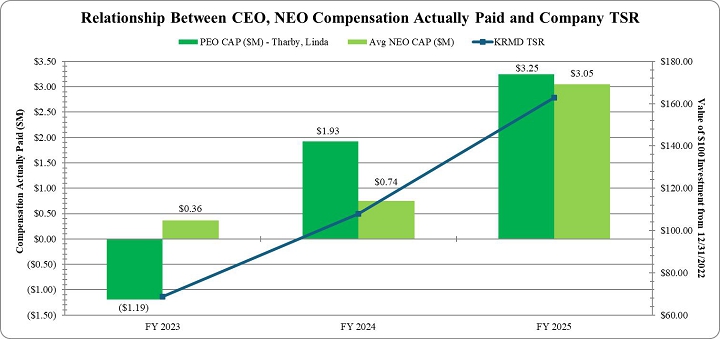
- 35 -
Description of Relationship Between NEO Compensation Actually Paid and Net Loss
The following chart sets forth the relationship between Compensation Actually Paid to our CEO, the average of Compensation Actually Paid to our Non-CEO NEOs, and the Company’s Net Loss over the fiscal three year period from 2023 through 2025.
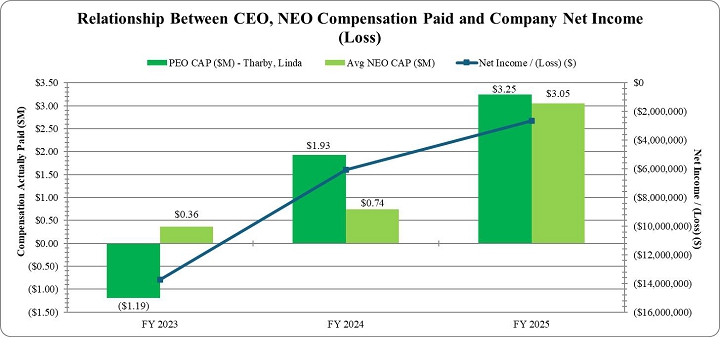
Equity Compensation Plan Information
The following table sets forth the equity compensation plans under which equity securities are authorized for issuance in the aggregate at the end of fiscal year 2025.
| Plan Category | Number of Securities to be Issued Upon Exercise of Outstanding Options, Warrants and Rights | Weighted-Average Exercise Price of Outstanding Options, Warrants and Rights | Number of Securities Remaining Available for Future Issuance Under Equity Compensation Plans (Excluding Securities Reflected in the First Column) | ||||||
| Equity Compensation Plans Approved by Security Holders | 3,348,951 | $3.25 | 1,632,381 | ||||||
| Equity Compensation Plans Not Approved by Security Holders(1) | 1,900,000 | $3.67 | 0 | ||||||
| Total | 5,248,951 | $3.40 | 1,632,381 | ||||||
__________
(1) Represents shares of restricted stock issued to new hires as inducement awards.
- 36 -
Securities owned by certain beneficial owners and management
The table below sets forth, as of April 8, 2026, the number of shares of common stock beneficially owned by each person owning more than 5% of the outstanding shares, by each named executive officer, director and director nominee, and by all executive officers and directors as a group. Except as otherwise noted, the address of each person is c/o KORU Medical Systems, Inc., 100 Corporate Drive, Mahwah, NJ, 07430.
We have determined beneficial ownership in accordance with the rules of the Securities and Exchange Commission (the “SEC”). Except as indicated by the footnotes below, we believe, based on the information furnished to us, that the persons and entities named in the table below have sole voting and/or investment power with respect to all shares of common stock that they beneficially own, subject to applicable community property laws. We are not aware of any arrangements, including any pledge by any person of the Company’s securities, which may result in a change in control of the Company. None of our current directors, executive officers, affiliates, any owner of record or beneficially of more than 5% of any class of our outstanding shares, or any associate of such persons, is a party adverse to us or has a material interest adverse to us required to be disclosed pursuant to Item 103(c)(2) of Regulation S-K.
Percentage ownership is based on 46,513,000 shares of common stock outstanding (including 576,426 shares of unvested restricted common stock entitled to vote) at April 8, 2026. In computing the number of shares of common stock beneficially owned by a person and the percentage ownership of that person, except as indicated by the footnotes below, we deemed outstanding shares of common stock subject to options held by that person that are currently exercisable or exercisable within 60 days of April 8, 2026, to be outstanding ignoring the withholding of shares of common stock to cover applicable taxes. We did not deem these shares outstanding, however, for the purpose of computing the percentage ownership of any other person. Beneficial ownership representing less than 1% is denoted with an asterisk (*).
The information provided in the table is based on our records, information filed with the SEC, and information provided to us, except where otherwise noted.
| Name of Principal Shareholders and Identity of Group | Shares Beneficially Owned |
Percent of Class |
|||
| Joseph M. Manko, Jr. (1) | 5,848,517 | 12.6 | |||
| Linda Tharby | 1,192,780 | 2.6 | |||
| R. John Fletcher | 226,800 | 0.5 | |||
| Thomas Adams | 302,647 | 0.7 | |||
| Christopher Pazden | 300,131 | 0.6 | |||
| Adam Kalbermatten(2) | 300,000 | 0.6 | |||
| Shahriar (Shar) Matin | 97,573 | 0.2 | |||
| Donna French | 94,943 | 0.2 | |||
| Robert Cascella | 94,584 | 0.2 | |||
| Eric Schiller(2) | 76,426 | 0.2 | |||
| Edward Wholihan | 47,741 | 0.1 | |||
| All Directors and Executive Officers as a Group | 8,299,795 | 18.5 | |||
| Horton Capital Management, LLC (1) | 5,848,517 | 12.6 | |||
| Topline Capital Management, LLC(3) | 3,941,014 | 8.5 | |||
| First Light Asset Management, LLC(4) | 3,831,475 | 8.2 | |||
| BlackRock, Inc.(5) | 2,345,369 | 5.0 |
__________
(1) Based solely upon a Form 4/A filed with the SEC on April 6, 2026, each of Mr. Manko, Horton Capital Management, LLC, a Delaware limited liability company (“HCM”), Horton Capital Partners, LLC, a Delaware limited liability company (“HCP”) and Horton Capital Partners Fund, LP, a Delaware limited partnership (“HCPF”) may be deemed to beneficially own 5,848,517 shares of common stock, including 5,065,970 shares of common stock held directly by HCPF and 782,547 shares held directly by Mr. Manko. Pursuant to investment advisory agreements, HCM maintains investment and voting power with respect to shares of our common stock held by HCPF. However, despite the delegation
- 37 -
of investment and voting power to HCM, HCP may be deemed to be the beneficial owner of such common stock because, in the event HCM's investment advisory agreement with respect to such common stock is terminated, HCP has the right to assume HCM's discretionary investment and voting authority with respect to such Common Stock. HCP is the general partner of HCPF. Mr. Manko is the managing member of both HCM and HCP. The address of Mr. Manko, HCM, HCP, HCPF and HFF is 1717 Arch Street, 39th Floor, Philadelphia, PA 19103.
(2) Includes shares of unvested restricted common stock that are deemed beneficially owned because the holder has sole voting power with respect to such shares, as follows: Mr. Kalbermatten – 300,000; Mr. Schiller – 76,426.
(3) Based solely upon an Amendment to Schedule 13G filed with the SEC on February 13, 2026, Topline Capital Management, LLC (“TCM”), Topline Capital Partners, LP (“Topline”) and Collin McBirney may be deemed to be the beneficial owners of 3,941,014 shares of common stock. TCM, as the investment manager and general partner of the Topline, and Collin McBirney, as the member-manager of TCM, may be deemed to beneficially own the securities held by the Topline.
(4) Based solely upon an Amendment to Schedule 13G filed with the SEC on February 17, 2026, First Light Asset Management, LLC (“First Light”) and Mathew P. Arens may be deemed to be the beneficial owners of 3,721,508 and 3,831,475 shares of common stock, respectively. First Light acts as an investment adviser to certain persons holding separately managed accounts with First Light, each of whom has the right to receive or the power to direct the receipt of dividends from, or the proceeds from the sale of, those shares. First Light may also be deemed to be the beneficial owner of these shares because it acts as an investment adviser to certain private funds. Mr. Arens may also be deemed to be the beneficial owner of these shares because he controls First Light in his position as managing member and majority owner of First Light. Mr. Arens also directly holds 88,167 Shares in an individual capacity with sole control and 21,800 Shares held in a joint account over which he shares control. The address of First Light and Mr. Arens is 3300 Edinborough Way #201, Edina, MN 55435.
(5) Based solely upon a Schedule 13G filed with the SEC on January 21, 2026, BlackRock, Inc. (“BlackRock”) may be deemed to be the beneficial owner of 2,345,369 shares of common stock. The address of BlackRock is 50 Hudson Yards New York, NY 10001.
Delinquent Section 16(a) Reports
Section 16(a) of the Exchange Act requires that our directors and executive officers, and persons who own more than ten percent (10%) of our common stock, file with the SEC reports of initial ownership of our common stock and subsequent changes in that ownership and furnish to us copies of all forms they file pursuant to Section 16(a). Based solely on a review of Forms 3, 4, and 5 furnished to us or filed with the SEC in fiscal year 2025, we believe all Section 16(a) filing requirements were timely made in the fiscal year ended December 31, 2025, except for three late Form 4s for Linda Tharby reporting an aggregate eight transactions, two late Form 4s for Thomas Adams reporting an aggregate six transactions, two late Form 4s for Christopher Pazdan reporting an aggregate nine transactions, one late Form 4 for Adam Kalbermatten reporting an aggregate two transactions, and one late Form 3 for Eric Schiller reporting zero transactions. Each of the aforementioned transactions reported on Form 4 related to securities issued as equity compensation pursuant to Section 16b-3 of the Exchange Act and/or sell-to-cover tax withholding transactions upon vesting thereof.
Changes to Procedures for Shareholder Nomination of Directors
We updated our procedures, as of February 5, 2026, for shareholders to submit director nominees at the Annual Meeting, which can be found in our Bylaws. Material changes to such procedures include increased disclosure requirements in a shareholder’s notice to the Company regarding information about the shareholder and the removal of the broad requirement to include any other information about the shareholder that would be required in a proxy statement under Section 14 of the Exchange Act. Such additional disclosures include, but are not limited to, (i) a description of any agreements or arrangements between the shareholder, director nominee or any other person; (ii) whether the shareholder intends to solicit proxies or deliver a proxy statement to holders of at least the percentage of shares of the Company entitled to vote on the election of directors; (iii) the shareholder or its representative intends to appear at the Annual Meeting to make such nomination; and (iv) a certification that the shareholder has complied with all federal, state and
- 38 -
other legal requirements. In addition, any stockholder that provides notice under Rule 14a-19(b) under the Exchange Act, must notify the Chairman of the Board within 2 business days of any change in the shareholder’s intent to solicit proxies from holders of shares representing at least 67% of the voting power of shares entitled to vote on the election of directors. No later than 5 business days prior to Annual Meeting, the shareholder must provide reasonable evidence that the shareholder has met the requirements of Rule 14a-19(a)(3) under the Exchange Act.
If there is an increase in the number of directors to be elected to the Board of Directors and such increase is not made public at least 10 days before the last day a shareholder may deliver a notice of nomination, a shareholder’s notice will be considered timely only with respect to nominees for any new position created by such increase, if the shareholder’s notice is received no later than the close of business on the 10th day following the day on which such increase was publicly announced by the corporation.
2027 Annual Meeting of Shareholders
Any shareholder proposals intended to be presented at our 2027 Annual Meeting of shareholders and considered for inclusion in our proxy materials must be received by December 5, 2026 and must comply with our Bylaws or the procedures of Rule 14a-8 under the Exchange Act. Shareholder proposals failing to comply with our Bylaws or the procedures of Rule 14a-8 under the Exchange Act will be excluded. If the date of our 2027 Annual Meeting is more than 30 days from the anniversary of the date of the 2026 Annual Meeting, we will publicly announce a different submission deadline from that set forth above, in compliance with SEC rules.
The below requirements under our Bylaws will not apply to a shareholder, if such shareholder notifies us of the shareholder’s intent to present the shareholder’s proposal at this year’s Annual Meeting only pursuant to Rule 14a-8 under the Exchange Act and such proposal has been included in a proxy statement that has been prepared by us to solicit proxies for the Annual Meeting.
Our Bylaws establish an advance notice procedure with regard to shareholder proposals that a shareholder wishes to present at an annual meeting of shareholders. To be properly brought before the 2027 Annual Meeting, a notice of the matter the shareholder wishes to present at the meeting must be delivered to the Chairman of the Board at the Company’s principal offices in Mahwah, NJ (see below) not less than 90 nor more than 120 days prior to the first anniversary of the date of this year’s Annual Meeting. As a result, any notice given by or on behalf of a shareholder pursuant to these provisions of the Bylaws (and not pursuant to Rule 14a-8) must be received no later than February 18, 2027 and no earlier than January 19, 2027. However, if the 2027 Annual Meeting is more than 30 days before or more than 60 days after the first anniversary of the date of this year’s Annual Meeting, such notice must be received no earlier than the close of business on the 120th day prior to such annual meeting and no later than the close of business on the 90th day prior to such annual meeting or, if later, the 10th day following the date public disclosure of the annual meeting date was made. All shareholder proposals must comply with the requirements of the Bylaws. The chairman of the Annual Meeting may refuse to acknowledge or introduce any such matter at the Annual Meeting if notice of the matter is not received within the applicable deadlines or does not comply with the Bylaws. If a shareholder does not meet these deadlines or does not satisfy the requirements of Rule 14a-8 of the Exchange Act, the persons named as proxies will be allowed to use their discretionary voting authority when and if the matter is presented at the Annual Meeting. In addition to satisfying the foregoing requirements under our Bylaws, to comply with the universal proxy rules, stockholders who intend to solicit proxies in support of director nominees other than management’s nominees must provide notice that sets forth the information required by Rule 14a-19 under the Exchange Act no later than March 20, 2027.
Shareholder proposals should be sent to us at KORU Medical Systems, Inc., 100 Corporate Drive, Mahwah, NJ 07430, Attention: Corporate Secretary.
Other matters
The Board is not aware of any matters to be presented at the 2026 Annual Meeting other than those set forth in the accompanying notice. If any other matters properly come before the meeting (or any adjournment or postponement thereof), the persons named in the proxy card will vote on such matters in their discretion in accordance with their best judgment.
- 39 -
Annex A
AMENDMENT NO. 1
TO
THE 2024 OMNIBUS EQUITY INCENTIVE PLAN
OF
KORU MEDICAL SYSTEMS, INC.
This Amendment No. 1 (this “Amendment”) to the KORU Medical Systems, Inc. 2024 Omnibus Equity Incentive Plan (the “Plan”), is hereby adopted as of April 3, 2026, by the Board of Directors (the “Board”) of KORU Medical Systems, Inc. (the “Company”). All capitalized terms used in this Amendment and not otherwise defined herein shall have the meanings set forth in the Plan.
WHEREAS, the Company adopted the Plan for the purposes set forth therein; and
WHEREAS, pursuant to Section 15.1 of the Plan, the Board has the right to amend the Plan;
NOW, THEREFORE, BE IT RESOLVED, that the Plan is hereby amended as follows:
1. That the first paragraph under Section 4.1 of the Plan is hereby deleted in its entirety and replaced with the following:
“Number of Shares Available for Grants. The number of Shares hereby reserved for issuance under this Plan is (i) four million six hundred thousand (4,600,000) Shares, plus (ii) any shares that may become available from expiration or termination of awards made under the Company’s 2021 Omnibus Equity Incentive Plan (the “2021 Plan”) and 2015 Stock Option Plan (the “2015 Plan”) prior to the Effective Date, which shall also be the maximum number of Shares that may be delivered pursuant to the exercise of Incentive Stock Options granted hereunder. In the event that any outstanding award under either the Plan, the 2021 Plan or the 2015 Plan for any reason expires or is terminated prior to the exercise thereof, the Shares allocable to the unexercised portion of such option shall continue to be reserved for Awards under the Plan and may be awarded hereunder. No further grants will be permitted under the 2021 Plan, the 2015 Plan or the and the Nonemployee Director Compensation Plan (the “Nonemployee Director Plan”). The total number of Shares reserved for Awards under this Plan (including those from the 2021 Plan and the 2015 Plan) and the limit on annual grants shall be subject to adjustment as provided in Section 4.2 and except as provided in Section 5.6(b).”
2. Except as specifically set forth herein, the terms of the Plan shall be and remain unchanged, and the Plan as amended shall remain in full force and effect.
The foregoing is hereby acknowledged as being Amendment No. 1 to the Plan, as adopted by the Board on April 3, 2026, subject to the approval of the Company’s stockholders in accordance with the terms of the Plan.
A-1